
Entry & progression
On a small vessel, you are the engineering department. There is no second engineer to consult and no shore team on the phone. What you do in the first sixty seconds decides most of what happens next.
Fire
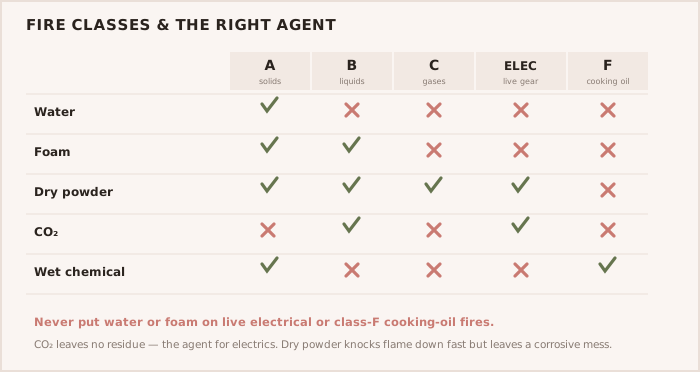
Engine room fire
- Raise the alarm. Before you fight it. Not after.
- Stop the fuel. The remote fuel shutoff exists for exactly this. A fire being fed by a pressurised fuel line is not a fire you win with an extinguisher.
- Stop the ventilation. Close the flaps and dampers. Fire needs air, and the fans are supplying it.
- Attempt it with a portable extinguisher only if it is small and you have a clear escape route behind you. If it is not small, or the route is not clear, get out.
- Evacuate and account for everyone. Every soul, by name.
- Seal the space and release the fixed system. Then leave it sealed - opening it to look feeds it fresh air and it will re-ignite.
Flooding
Water is heavy and it does not stop coming. The order is find it, stop it, pump it - in that order. Pumping a hole you have not found is a race you will lose, and it is surprisingly easy to spend ten minutes pumping while the water rises anyway.
- Find it. Where is the water coming in? Skin fittings, the stern gland, a failed hose on a seacock, the raw water system, a hull breach after a grounding.
- Stop it. Close the seacock. If it is a hose failure, that alone may stop it entirely. Softwood plugs are tied to every seacock on a well-run vessel for a reason.
- Pump it. Bilge pumps, emergency bilge suction, portable pump, buckets. All of them.
- Tell the bridge. Flooding is a stability problem, not just an engineering one. Free surface water sloshing across a compartment reduces stability fast, and the master cannot account for that if they do not know.
Loss of propulsion
The engine has stopped, or has had to be stopped. On a small vessel that means you are drifting, and the first question is not mechanical - it is where are we drifting to, and how long have we got? That is the bridge's question, and they can only answer it if you tell them at once.
| Symptom | Look at first |
|---|---|
| Stopped, will not restart | Fuel. Filters, air in the line, tank level, a bug-blocked primary in a seaway. |
| Stopped with an alarm | Whatever the alarm said. Oil pressure and overheat are the two that stop an engine and must not be reset and ignored. |
| Running, no drive | Gearbox, gearbox oil, coupling, shaft. Or something around the propeller. |
| Running, but rough / down on power | Fuel starvation, a fouled propeller, or a rope around the shaft. |
CAUTION — The alarm that stopped the engine was right The instinct under pressure - drifting, on a lee shore, with the master asking - is to restart and run on. If the engine stopped on low oil pressure or on overheat, restarting it converts a stopped engine into a destroyed one, and you will be drifting anyway, with no engine at all.
Tell the bridge what the alarm was and what restarting will cost. Let the master make that decision with the facts. It may still be the right call - but it is their call, and it must be an informed one.
The one rule
All three are a bridge problem before they are an engineering problem. Tell the master first. The instinct is to put your head down and fix it, and report once you have something useful to say. Fight it for the ten seconds it takes to pick up the phone. The master cannot navigate, call for assistance or alter course for a vessel they believe is fine.
You are not being judged on whether you fixed it alone. You are being judged on whether the vessel and everyone on it came home.