
Entry & progression
Loss of lubricating oil pressure will destroy an engine in under a minute. It is the one alarm you never rationalise, never reset, and never run on. Stop the engine.
- Lubricates - it keeps a film of oil between metal surfaces so they never touch.
- Cools - it carries heat away from pistons, bearings and the underside of the piston crown, which no coolant reaches.
- Cleans - it holds combustion soot and wear metal in suspension and carries them to the filter. This is why used engine oil is black. Black oil is oil doing its job.
- Seals - it fills the gap between piston rings and liner, helping hold compression.
The system
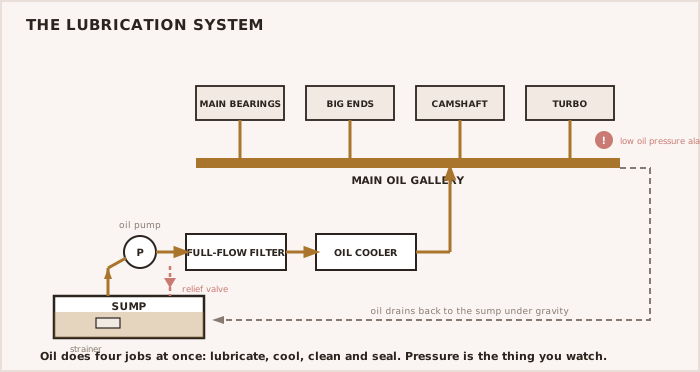
Oil is drawn from the sump through a strainer, raised in pressure by a gear-driven pump, pushed through a filter, often through an oil cooler, and then distributed through galleries to the main and big-end bearings, the camshaft, and the turbocharger. It drains back to the sump under gravity. A pressure relief valve protects the system when the oil is cold and thick.
Pressure and level are different things
| Reading | What it tells you |
|---|---|
| Level | How much oil is in the sump. Checked with the dipstick, with the engine stopped. |
| Pressure | Whether the pump can push the oil through the bearings. Checked with the gauge, engine running. |
You can have a full sump and no pressure - a failed pump, a blocked strainer, a bearing so worn the oil escapes through it faster than the pump can supply. And you can have pressure with a dangerously low level, right up until the pickup sucks air in a roll. Check both. They are not substitutes for one another.
WARNING — Low oil pressure: stop the engine There is no diagnosis to be made with the engine running. A bearing without an oil film welds itself to the journal, and that failure takes seconds, not minutes. The cost of stopping a main engine and being wrong is embarrassment. The cost of running on and being right is the engine.
Stop it. Tell the bridge. Then find out why.
Oil that is not right
| Symptom | Suspect |
|---|---|
| Level rising | Fuel or water getting into the sump. Leaking injector, cracked liner, failed cooler. |
| Milky, like coffee with milk | Water in the oil. Head gasket, liner seal, oil cooler. |
| Diesel smell, thin oil | Fuel dilution. The oil film is being washed off the bores. |
| Level falling | Burning it, or leaking it. Blue smoke says burning; a clean bilge says find the leak anyway. |
The discipline
Check the level cold, before starting, every day. Note the pressure at idle and at working load, and write both in the log so that a slow decline over a season is visible as a trend rather than as a surprise. Change the oil and the filter at the intervals in the manual, and do not stretch them because the engine sounds fine - by the time it does not sound fine, the damage has been done.
Oil is the cheapest component in the engine and the only one protecting all the others.