
Entry & progression
GNSS is a single point of failure with a very good record. A very good record is not the same thing as a redundant system. At command level you are expected to be able to navigate an ocean without it, and — more usefully — to know when it is lying to you.
The one you must do every day
Compass error by azimuth or amplitude. It takes four minutes with a sextant-free azimuth circle and a nautical almanac, and it is the check that catches a drifting gyro before the gyro catches you. If your bridge team cannot do this without supervision, they cannot do celestial navigation either, and you have a training problem, not a navigation problem.
The sun run sun, and the noon sight
- Sextant discipline. Index error checked every session, on the horizon or a star. Height of eye known — on a yacht's flybridge it is much greater than people assume, and the dip correction is not trivial.
- Corrections in order: index error, dip, then the main correction (refraction, semi-diameter, parallax as applicable). Sloppy corrections give tidy answers that are wrong.
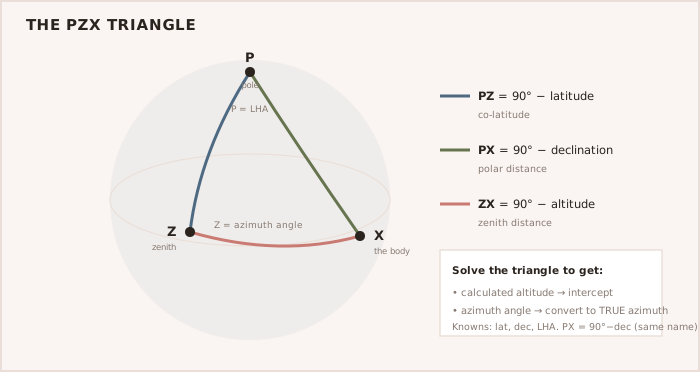
- The intercept method. Calculate the altitude and azimuth of the body from an assumed position; compare with the observed altitude; the difference is your intercept, toward or away along the azimuth. That is your position line.
- Meridian passage gives you latitude with almost no arithmetic. It is the most robust single observation on the ocean and it should be a habit, not an emergency measure.
- Star sights at twilight give a fix — three to five bodies well spread in azimuth, worked promptly. A small cocked hat is a good fix. A large one is a warning, not an average.
What you actually keep aboard
- A sextant that has been used this year, not one in a presentation box.
- The current nautical almanac, on paper.
- Sight reduction tables, on paper. An electronic almanac on the same laptop as everything else is not a backup.
- A deck watch or a chronometer error known against a time signal.
- Plotting sheets, dividers, a pencil that works.
TIP — The gyro check is the cheapest insurance on the vessel One azimuth of the sun, once a watch, logged. It costs nothing, it keeps the skill alive, it produces a documented trail if the compass is later questioned, and it is the single most likely way you will discover a fault in your primary heading reference. Make it a standing order and check that it is actually being done.
Command-level judgement
The exam will ask you to work a sight. The sea will ask you something harder: does this position agree with the others? Depth, radar range and bearing to a known object, celestial LOP, dead reckoning from the last confirmed fix, and the electronic position should all tell the same story. When one disagrees, you do not average them. You find out why.
That is the real purpose of celestial competence on a modern bridge. Not to cross an ocean with a sextant — you almost certainly never will. To have an independent source of truth that no software update, no jammer and no failed antenna can take away from you.