
Entry & progression
In an emergency the master has exactly one job, and it is not firefighting. It is command. The master who goes into the space, picks up a hose, or joins the search party has just removed the only person on board who can see the whole picture.
Everything that follows is about the first ten minutes, because the first ten minutes determine the next ten hours. They are also the minutes in which you will be least capable — adrenaline narrows your attention, destroys your time sense, and makes you certain of things you have not checked. That is why you use a drill and not your judgement.
The first ten minutes
- Sound the general alarm. Not a phone call to the chief engineer. The alarm. If it turns out to be nothing, you have run a drill.
- Stop the vessel doing harm to herself. Alter course to put the wind and sea where you need them. Stop engines, or don't, deliberately. Consider the list, the fire's air supply, the smoke path over the accommodation.
- Muster and account for everyone, by name. Not a headcount. Names, against a list, including guests, including contractors, including the day worker nobody logged. A missing person is an immediate search, not a later one.
- Set the boundaries. Close the watertight and fire doors. Shut down the ventilation to the affected zone. Isolate fuel to the space. This is the single highest-value action available to you and it takes seconds.
- Get one team, with one leader, on comms, going to look. Information beats speculation. Everyone else stands fast.
- Send the distress or urgency message EARLY. A Mayday cancelled is a paperwork problem. A Mayday sent late is a coroner's problem. If you are wondering whether it is bad enough to send, it is.
- Give the guests one crew member, one place, and one job. Frightened people who have been given a task and a location stop being a hazard.
- Make the decision that cannot be made late. Abandon. Beach her. Flood a space. Accept a tow. Every one of these gets harder every minute and impossible at some point. Identify which of them you are facing, and set the trigger for it now, out loud.
- Log the times. Delegate it if you must, but it happens from minute one.
- Rotate the team, and get water into them. Firefighting in a machinery space exhausts a fit person in fifteen minutes. Plan the second team before the first one is spent.
Communications
- MAYDAY — grave and imminent danger, immediate assistance required. PAN-PAN — urgency, no immediate danger to life. Know which you are sending and say it three times.
- DSC alert first, then voice. Position, nature of distress, assistance required, persons on board.
- Keep the office in the loop, but not on the bridge. Delegate company communications to somebody who is not commanding the casualty.
Deciding under uncertainty
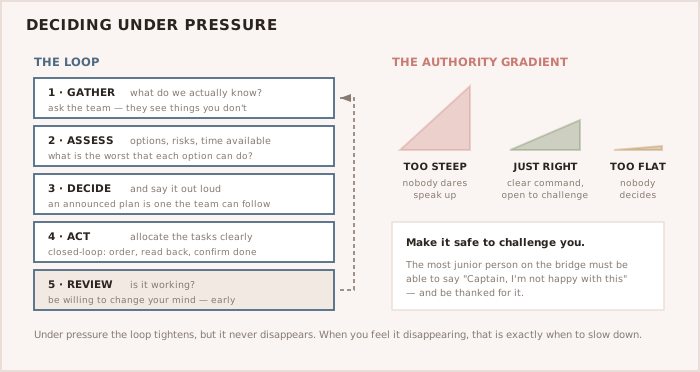
You will not have complete information and you are not going to get it. A good decision made now, on 70% of the picture, beats a perfect decision made twenty minutes late on 95%. The single most common failure in emergency command is not the wrong decision — it is no decision, taken by a master waiting for clarity that is never going to arrive.
WARNING — Abandon ship is the last decision. It must not be the late one. The vessel is the best lifeboat you have, right up until the moment she is not. Decide, in advance and out loud, what condition would make you abandon — a specific angle of heel, a specific fire boundary lost, a specific rate of ingress — and tell the officers what it is. A trigger set in cold blood is worth more than a judgement made in smoke.
And when it is over: the crew who performed will need to be told so, and the crew who froze will need to be told that they are not the first. Then the log, the report, the evidence — Lesson 3.3, in that order.