
Entry & progression
You will not calculate a stability condition from first principles at sea. You will read the approved stability booklet, and you will know enough to recognise when the number it gives you is wrong — because someone loaded something you were not told about.
The three points
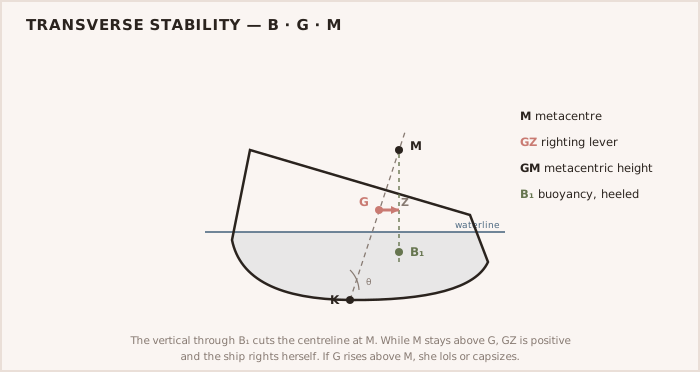
- B — centre of buoyancy. The centroid of the underwater volume. It moves as the vessel heels.
- G — centre of gravity. The centroid of the vessel's mass. It moves only when weight moves.
- M — the metacentre. Where the vertical through the new B cuts the centreline. For small angles, treat it as fixed.
GM = KM − KG. KM is a property of the hull form and the draft; you read it from the hydrostatics. KG is a property of the loading; you calculate it. GM is the difference, and it is your initial stiffness — how hard she resists the first few degrees of heel.
The GZ curve
GZ is the righting lever — the horizontal distance between the lines of action of weight and buoyancy at a given angle of heel. Plot GZ against angle and you have the curve that describes everything about the vessel's ability to come back.
- At small angles, GZ ≈ GM × sin θ. The initial slope of the curve is GM.
- Maximum GZ and the angle at which it occurs — how much righting moment she can generate, and how far over she has to go to generate it.
- Range of stability, ending at the angle of vanishing stability — beyond which GZ is negative and she will not come back.
- Area under the curve is dynamic stability: the energy required to heel her. This is what a gust, or a wave, actually delivers. A vessel can have a healthy GM and still be knocked down if the area is small.
Free surface effect
A slack tank kills GM. When the vessel heels, the liquid runs to the low side and G effectively rises — the virtual rise in G. The critical point, and it surprises people: the loss depends on the free surface area, not on how much liquid is in the tank. A tank with 5 cm of water in it produces essentially the same free surface loss as one half full.
WARNING — The yacht-specific free surface killers The swimming pool. The jacuzzi. The half-empty fuel tanks after a long leg. The tender bay with water in it. The bilge you have not pumped because the alarm has been nuisance-tripping. Every one of these is an unbudgeted free surface, and none of them is in the stability booklet's departure condition. Empty the pool before heavy weather. Press up or empty the slack tanks.
Weights that move
- Raising a weight raises G. The tender coming out of the garage on a crane raises G by w×d/Δ.
- A suspended weight acts at the point of suspension — the head of the crane — for as long as it is off the deck. The moment it lifts, G jumps. It does not creep.
- Guests migrate. Twelve people and their crew moving to one rail of the sundeck for a sunset is a real heeling moment on a fine-lined hull.
- Windage. A large superstructure and a beam wind is a steady heeling moment that the stability booklet accounts for and your eye does not.
The criteria
Intact stability criteria are conventionally expressed as minimum areas under the GZ curve up to 30° and 40°, a minimum GZ at 30°, a minimum angle at which maximum GZ occurs, a minimum initial GM, and a severe wind and rolling (weather) criterion.
CAUTION — Take the numbers from your booklet, not from memory The intact stability criteria that apply to your yacht come from her flag administration, her classification society, and her approved stability booklet — and large yachts are frequently assessed against a code written specifically for them. MO74 certificates the crew; it sets no stability criteria. Do not carry a set of remembered figures from a different regime and apply them to this vessel. Open the booklet.