
Entry & progression
Intact stability is arithmetic. Damage stability is a race. The vessel that survives a hole is the one whose watertight boundaries were closed before the hole appeared — and closing them afterwards is nearly always too late.
What flooding actually does
Water enters a compartment. Four things happen, and only the first is obvious.
- Bodily sinkage. She loses freeboard, and freeboard is reserve buoyancy.
- Trim and heel. Off-centre flooding heels her; end flooding trims her. Either can immerse an opening that was safe a minute ago.
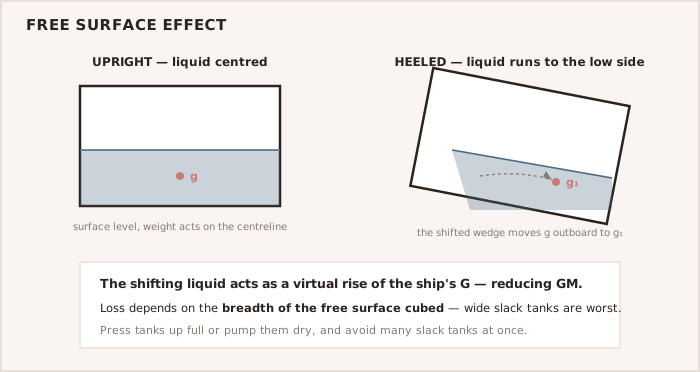
- Loss of GM. The flooded compartment has a free surface, and it is a very large one. This is usually the killer, not the added weight.
- Progressive flooding. Water moves. Through a cable transit, an unclosed door, a ventilation trunk, a bilge main. The compartment you flooded is not the compartment you will lose.
Two ways of thinking about it
- Added weight method — treat the floodwater as cargo loaded into the compartment. The displacement increases; G moves; the free surface of the floodwater reduces GM.
- Lost buoyancy method — treat the compartment as no longer part of the ship. Displacement and KG are unchanged; the waterplane changes, so KM changes. Often the more honest way to see it for a bilged compartment open to the sea.
- Permeability — the proportion of a compartment's volume that can actually flood. An engine room is full of machinery; a void is not. It matters, and it is in your damage control booklet.
Watertight integrity is a discipline, not a design feature
The naval architect gave you subdivision. Whether you still have it at 0300 is entirely a matter of what your crew do with doors. On a yacht, this is harder than on a cargo ship, because a yacht is designed to be open.
- The beach club and garage doors. Enormous openings, low in the hull, opened for guest operations, and closed by whoever remembers. This is the single most likely path by which a modern yacht will be lost.
- Shell doors and sea doors. Same logic. Dogged means dogged, not pushed to.
- Watertight doors left on 'open' for convenience during the working day.
- Cable and pipe penetrations disturbed during refit and never properly resealed. You cannot see these. Ask class.
- Hatches and skylights — decorative on many yachts, and structural to your survival.
The first ten minutes of a flooding casualty
Flooding response
- Close everything. General alarm, all watertight closures to the closed condition, ventilation to the affected zone shut down.
- Get numbers. Heel and trim, now, and again in five minutes. The rate of change tells you more than the value.
- Find the boundary. Which compartment, and which bulkheads is it pressing on? Send someone to feel and listen at the adjacent boundaries — a cold bulkhead is a flooded neighbour.
- Shore and seal. Stop the ingress or slow it. Wedges, shoring, collision mat, anything.
- Pump only when you know where the water goes. Cross-connecting a bilge main can flood a dry space.
- Do not counter-flood on instinct. It reduces heel and reduces reserve buoyancy. It is a calculated last resort, taken from the damage control plan — not a reflex.
CAUTION — Know which damage stability standard applies to your vessel Damage stability requirements for a given yacht depend on her flag, her tonnage, her class and the code she was built to. They are not set by MO74. Read the damage control plan and booklet for your vessel — know where it is, and know the downflooding angle and the compartment-by-compartment picture before the alarm sounds.