
Entry & progression
Almost no yacht is lost because the bridge team could not navigate. They are lost because somebody on that bridge saw the problem, and did not say it loudly enough, to the person who could have fixed it, in time.
The error chain
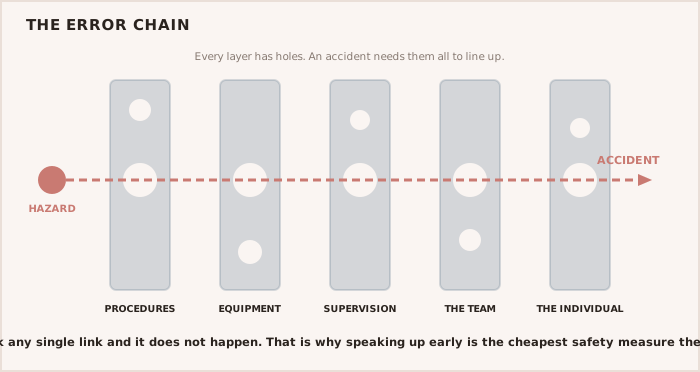
Accidents are almost never a single failure. They are a sequence: a poor plan, a distraction, an assumption, a missed cross-check, a junior officer who was uneasy and said nothing. Break any one link and the casualty does not happen. The last link is very often a person who knew.
The authority gradient — steeper on yachts than anywhere
On a merchant ship, the second officer who challenges the master may face an uncomfortable conversation. On a yacht, the second officer who challenges the master is challenging the person who decides whether they get the rotation next season, who signs their sea service letter, and who lives four metres away for eleven months of the year. The gradient is steeper, the crew are younger, and the consequences of speaking up feel more personal.
That gradient will not flatten itself. It flattens only because the master deliberately, repeatedly and visibly flattens it — and the crew believe it.
The tools
- Closed-loop communication. Order given, order read back, execution reported. Every time. It feels stilted for a week and then it saves you.
- Challenge and response. If a crew member has raised a safety concern twice and has not received an acknowledgement that resolves it, the standing order is that they escalate — call the master, take the con, stop the vessel. Say out loud that this is permitted, and mean it.
- Briefing. Before every arrival, departure and pilotage: the plan, the abort point, the roles, the contingency. Ninety seconds. It is the highest-value ninety seconds on the bridge.
- Situational awareness has three levels: perceiving what is there, understanding what it means, and projecting what it will mean. Teams almost always fail at the second and third. 'I saw the target' is not situational awareness.
- Fixation. The whole team looking at the same screen is the classic symptom. Somebody must be looking out of the window. Say whose job that is, by name.
Fatigue
STCW sets an international floor for hours of rest: a minimum of 10 hours in any 24-hour period and 77 hours in any 7-day period, with the rest divided into no more than two periods, one of which must be at least 6 hours, and intervals between consecutive rest periods not exceeding 14 hours.
CAUTION — The Australian implementing instrument is not in this course's source base The Marine Order that gives effect to the STCW rest-hour standard for regulated Australian vessels — and any permitted exceptions to it — was not confirmed against a primary source for this course. Get the applicable requirement from AMSA and from your flag, and check it against what your SMS says. Do not run a watch bill from a remembered number.
And be honest about the industry you are in. Charter season, a 3-watch bridge on paper, a crew doing guest service until 0200 and turning to at 0700. Rest hour records that are complied with on the form and not in the bunk are a lie you are signing. The master owns that.
The culture
What you tolerate is what you have taught. If a near-miss is reported and the reporter is made to feel foolish, you have just closed your last honest information channel. If a corner is cut in front of you and you say nothing, you have authorised it. The master sets the culture in the first fortnight, mostly without noticing, and it holds for the whole season.