
Entry & progression
The 6 understudy months are not just months. They are a structured, hour-counted programme with four separate tallies, and they must be run inside an approved deck watchkeeper understudy program. Start logging on day one or you will do them twice.
This is the part of the certificate that people underestimate. The 36 months feel like the mountain. In practice the thing that sends applications back is the understudy programme, because it is the only part of the service that is counted in hours, in four separate buckets, and it cannot be reconstructed after the fact from memory.
The four tallies
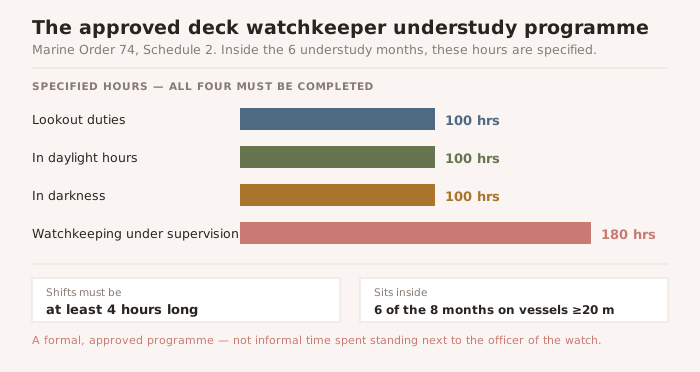
| What | How many hours |
|---|---|
| Duties as lookout | 100 hours |
| Daylight hours | 100 hours |
| Darkness | 100 hours |
| Watchkeeping under supervision | 180 hours |
And a structural rule that sits over all of it: the understudy service must be performed in shifts of at least 4 hours. A scatter of twenty-minute stints on the bridge while the mate has a coffee is not understudy time. Four hours is the floor.
The programme must be approved, and the service must be performed as understudy of the officer in charge of a navigational watch — or as OICNW on a vessel AMSA considers equivalent. Someone senior is watching you and signing for you. That is the point of the word understudy.
How a day is counted — MO74 Schedule 3
Converting hours on watch into days of sea service
- Look at each 24-hour period separately.
- If you performed master or deck officer duties for at least 8 hours in that 24-hour period, the service counts as a whole day.
- If you performed less than 8 hours, the service counts as the actual hours served plus 25% of that time.
- You can never credit more than one day per 24 hours, no matter how many hours you stood.
Work an example. Six hours of watchkeeping in a day gives you 6 + 1.5 = 7.5 hours, not a day. Twelve hours gives you one day — and not one and a half. The ceiling is hard and the floor is generous only in the sense that short days are not simply thrown away.
TIP — The 25% uplift rewards consistency, not heroics Two six-hour days beat one twelve-hour day: 7.5 + 7.5 hours against a flat single day. The rule is quietly telling you what a watchkeeper is — someone who turns up every day, not someone who does an epic and then sleeps for two.
Keep the log yourself
Nobody else will keep it for you. Record the date, the vessel, her length, the voyage, the start and end time of each shift, whether it was daylight or darkness, what you were doing — lookout, or watchkeeping under supervision — and get it signed by the OICNW at the time, not eight months later when you cannot find him.
CAUTION — Sea service letters — international rules are the opposite of domestic For an international certificate, AMSA requires qualifying sea service to be confirmed by a letter issued by the company. Verbatim: letters issued on board a vessel by a master will not be accepted. For domestic near-coastal certificates, a letter from the master, owner, operator or chief engineer is accepted.
MO74 is international. Get the company letter. A beautifully signed captain's letter will not save an application, and getting this backwards can invalidate months of accrued time. Confirm the current evidence requirements with AMSA before you sail.