
Entry & progression
COLREG Rule 7 requires proper use of radar equipment, including long-range scanning and radar plotting. Proper use is a legal standard. It means you understand what the picture is not showing you, as well as what it is.
What the picture cannot show you
- Targets that do not reflect. Wooden and GRP hulls, small craft, ice, a semi-submerged container. The radar cross-section, not the physical size, determines what you see.
- Targets in the sea clutter. Turn the clutter control up and you erase the small target you most need. Turn it down and you cannot see anything for the noise. Tune it by hand and know what you have suppressed.
- Targets in the shadow. Behind an island, behind a headland, behind a large ship, or inside the blind arc caused by your own mast and superstructure.
- Anything inside the minimum range or below the vertical beam — the close-in blind zone that grows with radar height. On a yacht with a scanner on an arch, this is a real distance.
- The aspect of a target, its intentions, or whether the man on it is awake.
What it shows you that is not there
False echoes are common and every one of them has a signature: side-lobe echoes appearing as an arc of contacts at the same range as a strong close target; indirect echoes reflected off your own mast, appearing on a constant bearing in the blind arc; multiple echoes at exact multiples of a close target's range; and super-refraction or ducting returning targets far beyond the normal horizon in the exact atmospheric conditions that also produce beautiful evenings.
ARPA — automatic, and only that
ARPA acquires a target, tracks it, and computes CPA, TCPA, target course and target speed. It is a superb tool and it is arithmetic, not perception.
WARNING — Target swap — the ARPA failure that kills When two targets pass close to one another, ARPA can swap the tracks — assign target A's history to target B and vice versa. The vectors then look entirely plausible and are entirely wrong.
It also takes ARPA up to three minutes to settle after a target manoeuvres, or after your own vessel manoeuvres. In that window the vector is stale. This is exactly the window in which a collision is decided.
Check the ARPA against the raw echo trail. Always.
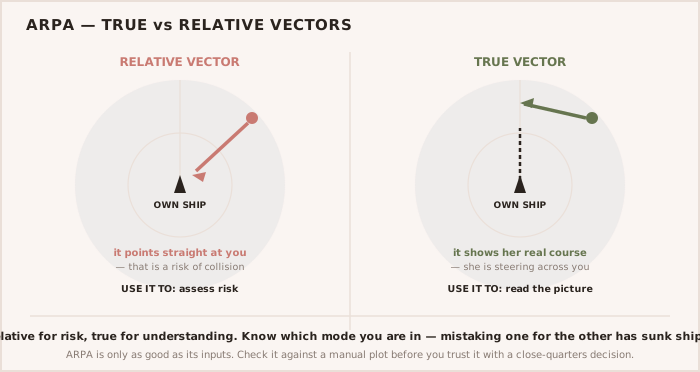
True vectors and relative vectors
| Mode | Shows | Use it to |
|---|---|---|
| Relative vector | Where the target will be relative to you | See collision risk instantly — a relative vector pointing at your own ship is a collision. |
| True vector | The target's actual course and speed through the water | See what the traffic is doing — who is anchored, who is fishing, who is overtaking whom. |
Use both. Watchkeepers who live in one mode make characteristic mistakes: the true-vector-only officer misses a developing collision; the relative-vector-only officer cannot understand the traffic picture. Switch between them deliberately, and know which mode you are in.
NOTE — AIS is not a radar AIS shows you what a vessel says about itself. It does not show unfitted vessels, switched-off transponders, wrong manual entries, or anything that is not a vessel. Radar shows you what actually reflects. They are checks on each other and neither is a substitute for the window.