
Entry & progression
Anchoring is a calculation followed by a manoeuvre, and on a yacht it is usually done in a crowded bay in front of an audience. The watchkeeper's part in it does not end when the brake goes on. That is when it starts.
Before you let go
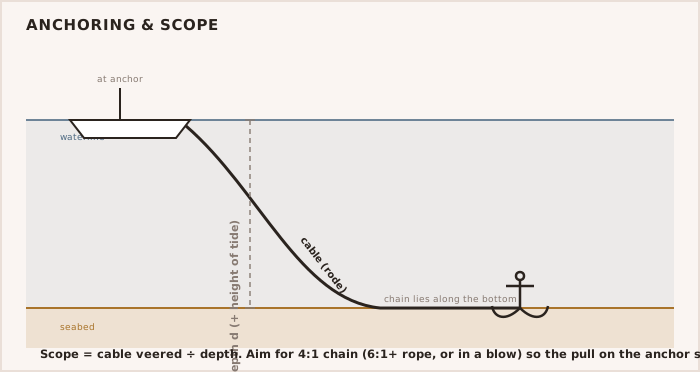
The anchoring appraisal
- The holding ground. Sand and mud hold. Weed, rock and coral do not — and coral you must not damage in any case. Read the chart, and read the sailing directions.
- The depth, worked at the height of tide you will have at low water, and the depth you will have at high water for scope.
- The scope. A working rule of thumb in good conditions is around five times the depth, and more — considerably more — in poor holding or bad weather. Take the actual figure from the vessel's own procedures.
- The swinging circle — scope out plus the vessel's length — and what is inside it: other yachts, shallow patches, cables, moorings, the shore.
- The weather, for the whole period you intend to lie there, plus the period you did not intend to.
- The escape route. How you leave, in the dark, in a hurry, with the wind from the worst direction.
The anchor watch
Set the GNSS anchor alarm — and do not believe it on its own. Take transits ashore and compass bearings of fixed objects, and write them down. Watch the echo sounder: a change in depth is often the first sign you have moved. And feel the cable — a dragging anchor produces a characteristic jerking, and a cable that goes from catenary to bar-taut is telling you something.
WARNING — Dragging is quiet It does not announce itself. The vessel does not lurch. She simply moves, slowly, downwind, while everybody is looking at something else. By the time it is obvious, the sea room is gone.
If you suspect you are dragging, act. Engines ready, call the master, and be prepared to weigh and re-anchor. Nobody has ever regretted re-anchoring. People have drowned waiting to be sure.
Weighing
Motor up to the anchor rather than dragging the vessel up to it with the windlass. The windlass lifts the anchor; the engines move the ship. Report the cable's direction and its weight as it comes in — up and down, anchor aweigh, clear anchor — and mean each of those words, because the master is conning on them.
Mooring lines
The failure mode is a snap-back. A mooring line under load stores enormous energy and, when it parts, releases it along the line and in a wide zone either side of it. A parting line will kill anyone standing in that zone.
- Know where the snap-back zone is, and do not stand in it. Not for a moment. Not to take a photograph. Not to help.
- Never stand in a bight of rope. Never step over a line under load or about to come under load.
- Never mix ropes and wires on the same bollard or in the same function. They stretch differently; the stiffer one takes all the load and parts.
- Gloves, boots, no loose clothing. Winches and capstans do not let go.
- One person gives the orders. On a Mediterranean stern-to berth, with a passerelle and lazy lines and a crosswind, that discipline is the only thing between you and a very expensive afternoon.