
Entry & progression
MO74 s8(2) makes ECDIS training a condition of serving on an ECDIS-equipped yacht. Almost every yacht you will keep a watch on is one. This lesson is about the two settings that everybody enters and almost nobody understands.
The safety contour — the line that defines your water
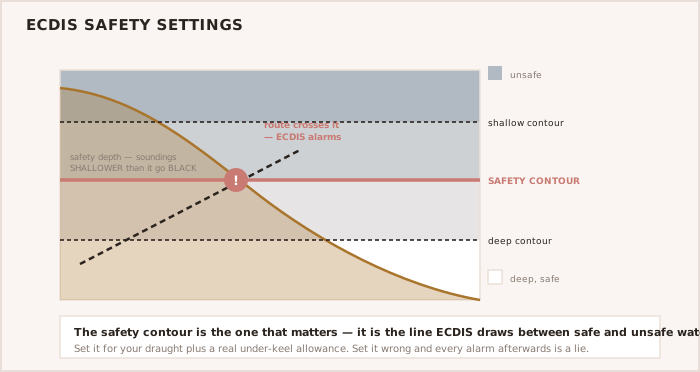
The safety contour divides the chart into water you may navigate in and water you may not. It is the single most important setting on the system.
- It drives the anti-grounding alarm. Crossing it, or a look-ahead sector touching it, generates an alarm.
- It is the line the route check uses when it tells you a planned leg is unsafe.
- It is drawn as a bold, emphasised line on the display — deliberately conspicuous.
- It divides the depth shading into deep water and shallow water.
WARNING — ECDIS cannot draw a contour that does not exist The system can only use a depth contour that is in the chart data. If you ask for a safety contour of 12 m and the cell contains only 10 m and 20 m contours, ECDIS will default to the next deeper available contour — 20 m — and it should indicate that it has done so.
The safety contour actually in use may therefore be deeper than the one you typed. That is safe. What is not safe is assuming the number on the screen is the number you entered. Check which contour the system is actually using.
The safety depth — the number that turns soundings black
The safety depth does something entirely different, and the two are constantly confused.
NOTE — Get this the right way round Under IHO S-52, individual soundings SHALLOWER than the safety depth are displayed in BLACK — emphasised, so your eye is drawn to them. Soundings deeper than the safety depth are displayed in grey, de-emphasised.
Black means danger. It is the opposite of the intuition many people arrive with. The safety depth is about the emphasis of individual spot soundings, not about area shading or alarms.
| Safety contour | Safety depth | |
|---|---|---|
| What it acts on | Depth areas — the shading of the chart | Individual spot soundings |
| What it produces | The anti-grounding alarm and the route check | Black soundings shallower than it; grey soundings deeper |
| Displayed as | A bold, emphasised line | No line at all |
| If the value is unavailable | Defaults to the next deeper contour in the data | Applies as set — soundings are point data |
Setting them
The values follow from the vessel, not from habit. Take the draught, add the squat at the speed you intend, add the safety margin the company or the master requires, and add whatever allowance you make for height-of-tide uncertainty and swell. The number that falls out is the number you use. Then look at what contour ECDIS has actually adopted, and if it has jumped to 20 m, you now know something important about the water you are about to enter.
WARNING — The alarm is not the navigator ECDIS will happily let you plan and sail a route that is perfectly legal, perfectly alarm-free, and stupid. It knows nothing about traffic, weather, a failing generator, or the tender you have in the water. Turning off nuisance alarms because they are annoying is how a bridge ends up with no alarms at all on the night it needs one.