
Entry & progression
100 of your understudy hours are logged as lookout. That is not an administrative accident. Lookout is the first duty in the COLREGs, the first thing to decay on a quiet watch, and the last thing anybody trains properly.
What the eye actually does in the dark
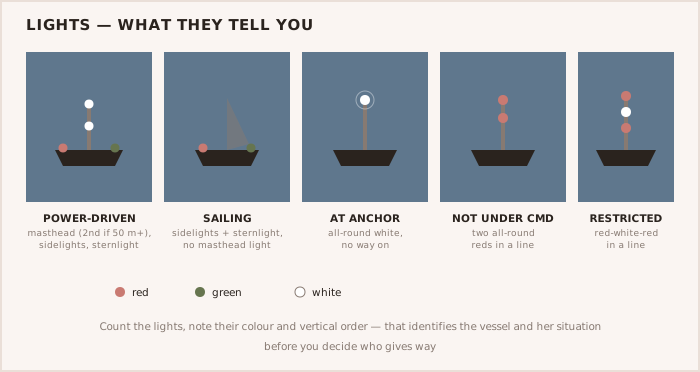
Your retina has two kinds of receptor. Cones live in the centre of your vision, give you colour and fine detail, and are almost useless below a certain light level. Rods live off-centre, see no colour, resolve very little detail — and are what you actually see with at night.
That gives you a night blind spot in the centre of your vision. Look directly at a dim light on a black horizon and it will vanish. This is not fatigue and it is not imagination. It is anatomy.
TIP — Off-centre scanning — the technique that finds the unlit boat Do not stare. Scan in short, deliberate steps, pausing a few seconds on each sector, and look slightly to one side of where you expect the target to be. The dim contact appears in your peripheral vision, not your central vision.
It feels wrong. It works. It is how you find an unlit yacht, a fishing float, a half-submerged container, and the small craft with no AIS and a radar cross-section the size of a bucket.
Dark adaptation
- Substantial adaptation takes 10 to 15 minutes. Full adaptation takes considerably longer — think in tens of minutes, not seconds.
- One glance at a white light destroys it. A phone screen, a chart-table lamp, a saloon door opening onto the bridge — all of it, gone in an instant.
- Red light preserves it best. Keep the bridge red, keep it dim, and keep it dimmer than you think you need.
- Anything that reduces oxygen uptake — smoking, fatigue, altitude, illness — degrades night vision measurably.
Why the screens are the danger
The instruments on a modern yacht bridge are bright, informative and interesting. They are also a trap. Every minute spent head-down on ECDIS is a minute your night vision is being burned away and the window is unwatched. The screens supplement the lookout. They do not replace it.
And what the screens cannot show you is precisely the thing most likely to kill you: the small wooden fishing boat with no AIS transponder, no radar reflector and one paraffin lamp, in the middle of nowhere, at three in the morning.
The sole lookout question
The officer of the watch may act as sole lookout in daylight, and only after a careful appraisal of visibility, traffic density, proximity of dangers, and the workload of the watch — and only where it has been positively established that it is safe to do so. The moment any doubt arises, call the lookout back to the bridge.
WARNING — Never sole lookout at night The practice of the sole lookout does not extend to darkness. Small yachts run thin bridge teams and there is constant pressure — from the schedule, from the manning, from the culture — to stand a night watch alone. Resist it. The one time it matters, you will be looking at a screen.
Hearing counts too. Rule 5 says sight and hearing. Open a bridge wing door in restricted visibility. You cannot hear a fog signal through a closed window and a set of headphones.