
Entry & progression
Tide is the one navigational variable that is entirely predictable and routinely ignored. A yacht draws less than a ship and that breeds a carelessness the seabed does not share. Under-keel clearance is a calculation, not a feeling.
Height, datum, and the number on the chart
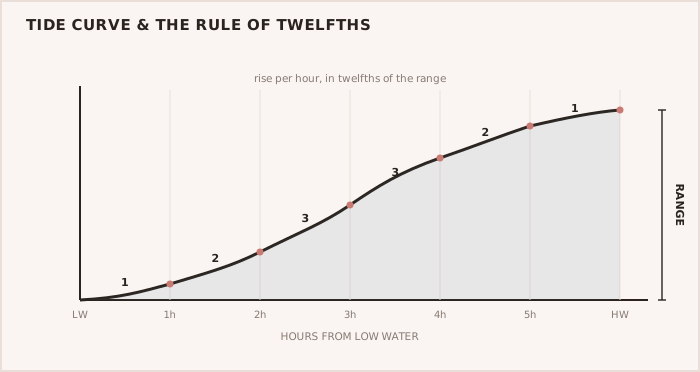
- Chart datum is the level below which the tide seldom falls — the zero of the soundings.
- Charted depth is the depth below chart datum. It is not the depth you will find.
- Height of tide is the height of the water above chart datum at a given time.
- Depth of water = charted depth + height of tide.
- Drying heights — the underlined figures — are heights above chart datum. They are the ones that surprise people.
- Charted heights of lights and bridges are measured above a different datum — usually MHWS. Air draught and depth do not share a zero.
Under-keel clearance
Working the UKC honestly
- Take the charted depth at the shallowest point on your track.
- Add the height of tide at the time you will actually be there — not at high water, and not now.
- Subtract your draught — the real one, with fuel, water, tenders and toys aboard, not the one in the brochure.
- Subtract squat, which grows sharply with speed and in shallow water.
- Subtract an allowance for swell, for the accuracy of the survey, and for the possibility that the forecast height of tide is wrong.
- What is left is the clearance. If it is not comfortable, do not go, or go later.
WARNING — Squat is not a small correction A vessel moving through shallow water sinks bodily and changes trim. The effect grows rapidly with speed and rapidly as the depth-to-draught ratio falls. A yacht that draws 3 m in deep water can draw appreciably more at speed in 6 m of water.
Slow down in shallow water. It costs minutes. Squat has grounded vessels whose static UKC was perfectly adequate.
Tidal streams
Streams are found in tidal stream atlases, on tidal diamonds on the chart, and in sailing directions. They are given as set — the direction the water is going to — and drift — how fast. Rates are usually tabulated for springs and neaps, and interpolated between.
Two things about them are worth more than any table. First, in a channel the stream runs fastest in the deepest part and slackest at the edges — which is exactly the opposite of where a nervous watchkeeper wants to be. Second, slack water and high water are not the same moment. In many places the stream is still running hard at high water. Plan to the stream, not to the height.
Springs and neaps
Springs — sun and moon aligned, around new and full moon: the biggest range and the strongest streams. Neaps — sun and moon at right angles, around the quarters: smallest range, weakest streams. A neap high water may be substantially lower than a spring high water, which is precisely how a vessel that got in last week fails to get in this week.
CAUTION — Australian tidal ranges are not the Mediterranean's Parts of the Australian coast have tidal ranges an order of magnitude greater than a Mediterranean-trained crew has ever seen, and tidal streams to match. This course does not state any specific figure. Take the numbers from the current official tide predictions and the current chart for the place you are actually going.