
Entry & progression
The first thirty seconds decide it. On a yacht the person in the water is very often a guest, at night, who was not wearing a lifejacket and whose absence nobody noticed. The single most valuable thing on that bridge is a watchkeeper who acts before thinking, in the right order.
The immediate actions — in this order
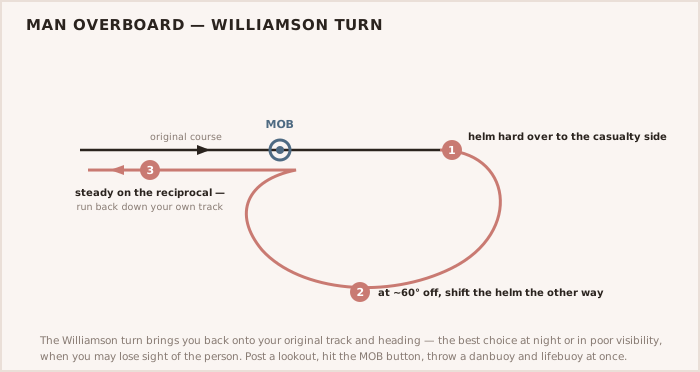
The moment someone goes in
- Shout 'man overboard', port or starboard. Get the whole vessel moving with one word.
- Throw a lifebuoy — with a light and smoke — immediately, even if it lands nowhere near them. It marks the water and it gives them something to swim to.
- Wheel over towards the casualty's side. This throws the stern — and the propellers — away from them. It is the single most important helm action you will ever take.
- Post a dedicated spotter who does nothing else, ever, but point at the casualty. Not a lookout with other duties. One person, one arm, one job.
- Press the MOB button on the GNSS/ECDIS. Note the time and the position.
- Sound the alarm, call the master, and inform the engine room.
- Reduce to manoeuvring speed. Take the vessel off autopilot and hand-steer.
- Transmit. DSC distress alert if the situation warrants; Mayday or an urgency call on VHF Ch 16 to bring other vessels in.
WARNING — Never lose sight of the person A head in a seaway is invisible at fifty metres. Once the spotter loses them, the probability of recovery collapses — and it collapses fast. The spotter's only job is to keep pointing. Do not give them anything else to do. Do not let anyone talk to them. Relieve them, but do not remove them.
The recovery turns
| Turn | When to use it | Why |
|---|---|---|
| Williamson | The casualty is not in sight — a delayed or discovered MOB, or at night | It brings the vessel back onto her own reciprocal track. It is the turn that finds a person you cannot see, because it retraces the ground. |
| Anderson (single turn) | The casualty is in sight and the vessel is highly manoeuvrable | The fastest turn. It is also the hardest to judge and does not return you to the track — so it is only for when you can see them. |
| Scharnow | Delayed discovery, and you need to return to the track | Returns to the track without passing back over the point of turn. Not for use when the position of the casualty is close and known. |
The recovery itself
Getting a person back out of the water is where these go wrong. A cold, exhausted, possibly unconscious adult in a swell is a very heavy, very awkward load, and a yacht's topsides are high.
- Approach on the leeward side so the vessel drifts down to them, not over them.
- Stop the propellers before they come alongside. Confirm it.
- Use the rescue boat if it is safe to launch — it is almost always faster than manoeuvring the mother vessel.
- Lift them HORIZONTALLY wherever possible. A casualty who has been in cold water may collapse — post-rescue collapse — if lifted vertically. This is a real, documented phenomenon and it kills people after they have been recovered.
- Treat for hypothermia and handle them gently. Do not let them exert themselves.
Practise it. In daylight, with a dummy, until the first four actions happen without a conversation. The night it happens for real, nobody is going to read the card.