
Entry & progression
Every position line you take by eye depends on a compass, and every compass is wrong. The competence is not in having a perfect instrument. It is in knowing how wrong it is, today, on this heading — and in checking it every watch.
The magnetic compass — two errors, in strict order
| Variation | Deviation | |
|---|---|---|
| Caused by | The Earth's magnetic field differing from true north | The vessel's own magnetism and her steel and electrics |
| Varies with | Position and time (it changes annually) | The vessel's heading — and with what has been left near the binnacle |
| Found from | The compass rose on the chart, corrected for the year | The vessel's deviation card, entered with the ship's head |
Compass to True — and back
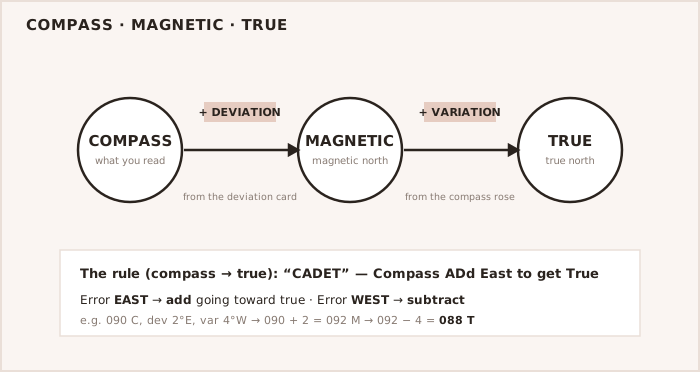
- CDMVT — Compass, Deviation, Magnetic, Variation, True. Going this way (compass to true), add easterly errors and subtract westerly errors.
- Reverse the process to go from True to Compass, and reverse the signs with it.
- The mnemonic that survives the oral: 'Can Dead Men Vote Twice? — At Elections, Yes.' Compass, Deviation, Magnetic, Variation, True; Add East.
- Never apply variation before deviation. Deviation is entered with the compass heading, and applying them out of order produces an error you will not notice.
WARNING — The mobile phone on the binnacle Deviation is caused by ferrous mass and electrical current near the compass. A phone, a handheld VHF, a torch, a laptop, a speaker, a toolbag left on the console by a contractor — every one of them can throw the magnetic compass by degrees.
A deviation card is only true for the ship as she was when it was swung. Keep the area around the binnacle clear, and treat any unexplained change in deviation as a real finding, not a nuisance.
The gyro — one error, and one dependency
A gyro compass seeks true north, so it has no variation and no deviation. What it has is gyro error — a single figure, expressed as so many degrees high or low — and a total dependence on power. It also needs time to settle after a start-up, and it is subject to speed, latitude and course/speed-change errors which a modern unit corrects automatically, provided it is being fed a correct speed and latitude input.
Checking the compass — every watch
The standard is not when it seems necessary. It is at least once a watch, and after every major alteration of course.
- By transit. Two charted objects in line; compare the charted transit bearing with the bearing you observe. This is the best check available and it needs no calculation.
- By an azimuth of a celestial body — the sun, a star, the pole star. The traditional method and still a fair one.
- By comparison — gyro against magnetic, and both against the known charted bearing of a distant object.
- By the ship's head — magnetic against gyro, applying the deviation for that heading.
- Record it. In the compass error book, every watch, with the time and the method. It is the record that reveals a slow drift, and a slow drift is the one that gets you.
A watchkeeper who cannot tell you today's gyro error is telling you they have not checked it. That is the answer the oral examiner is listening for, and it is the answer the seabed is listening for too.