
Entry & progression
The final lesson. An emergency on a yacht is an emergency with untrained, non-English-speaking, possibly elderly passengers who have never seen a lifejacket and who will look at the crew to decide how frightened to be. What they see is what they will do.
The general emergency alarm
Seven or more short blasts followed by one long blast, on the ship's whistle and on the general alarm bell. It means go to your muster station. It does not mean abandon ship. The order to abandon ship is given by the master, and by the master alone, and it is given by word of mouth or by public address — never by a bell.
The first minute
Whatever the emergency, the shape is the same
- Raise the alarm. Do not investigate first. Do not decide whether it is worth it. Raise the alarm, then investigate.
- Locate and identify — what is it, where is it, is anyone hurt, is anyone missing.
- Contain. Close the boundaries. Stop the flow. Shut off the fuel. Isolate the electrics.
- Muster. Account for every single person on board, crew and guests, by name, against a list.
- Inform. The master, the engine room, the shore, and — if you need help — everybody on Channel 16.
Fire
A yacht is a fire risk with a mooring line. Enormous quantities of fuel, high-power electrics, lithium batteries in every toy and tender, a commercial galley, a workshop, and interior finishes that are flammable, expensive and produce lethal smoke. Boundary cooling and closing the space is a watchkeeper's action. Fighting the fire in the space is a trained team's action.
WARNING — A fixed gas system requires a headcount first Before a fixed fire-extinguishing system is released into a machinery space, every person must be accounted for and out of that space, and the space must be sealed. Ventilation stopped, dampers closed, fuel shut off, doors shut.
This is a positive, verified, person-by-person confirmation. Not an assumption. Not a shout down the stairs.
Abandon ship — the last resort
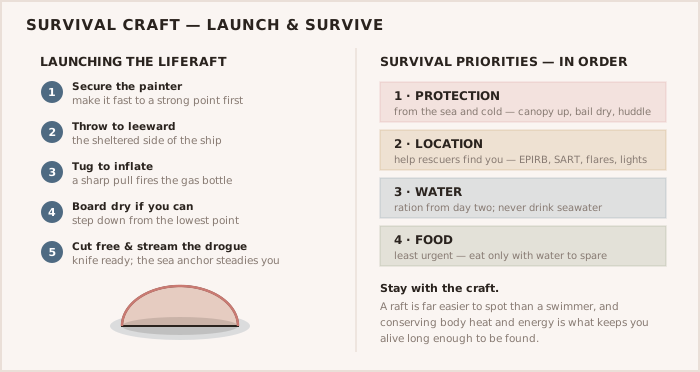
You step up into the liferaft. The vessel is almost always a better survival craft than the raft is, and vessels have been abandoned that then stayed afloat for days while their crew died of exposure alongside. Abandon only on the master's order, and only when the vessel is genuinely lost.
- Immersion suits and lifejackets on — properly, fully, with the crotch strap done up. A lifejacket worn loosely will ride up over a casualty's head in the water.
- Grab bag, EPIRB, SART, handheld VHF, water, medical kit. Somebody's named duty on the muster list, done without being asked.
- Board dry — into the raft from the vessel, if it can possibly be done.
- Get clear, then get together. Raft to raft, tied together, sea anchor out. A group is vastly easier to find than an individual.
- Cold kills faster than anything else. Huddle. Cover. Do not swim unless you are swimming to something you can see.
The last word of this course is the first thing you should have learned on the first day, and it is the reason the certificate you are studying for exists at all: the watchkeeper is the person who is awake. Everything else on the ship can be replaced.