
Entry & progression
Course: high-voltage safety and operation for marine engineers, at operational and management levels — required where a vessel has HV electrical systems (typically above 1000 V). Entry: marine engineering officer or trainee. Supports the engineering CoC pathway on HV-equipped vessels.
Respecting high voltage
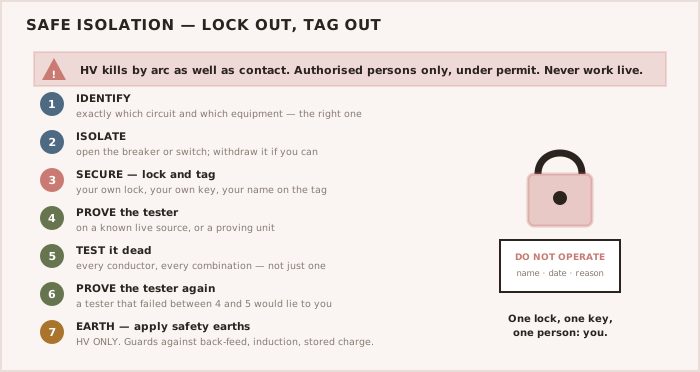
Marine high voltage — typically above 1000 V — carries the risk of fatal electric shock, and of arc flash, an explosive release of energy that can burn severely without any contact at all. Work on HV therefore follows a strict, formal safe system: authorisation and a permit to work, isolation of the circuit, locking off, proving the circuit dead with an approved and proven tester, and applying earths before any work begins. Only trained, authorised persons operate HV switchgear, and the procedures exist precisely to make certain that no one is ever exposed to a live high-voltage conductor.
Safe isolation of an HV circuit (principle)
- Obtain authorisation and a permit to work for the task.
- Isolate the circuit and lock off the isolator so it cannot be re-energised.
- Prove the circuit dead with an approved tester — and prove the tester before and after.
- Apply earths as required before any work on the circuit begins.
WARNING — Arc flash can kill without contact High voltage can flash over through the air without any physical contact, releasing an explosive burst of heat and energy. Correct isolation, earthing, safe distance and the right PPE are not optional — they are what makes HV work survivable.
NOTE — Authorised persons only, under a permit HV switchgear is operated only by trained, authorised persons, under a permit to work. The formality is the safeguard; there is no room for the informal shortcuts that low-voltage work sometimes tolerates.