
Entry & progression
Certificate: MCA Officer of the Watch (Yachts) <3000 GT, STCW Regulation II/1. Route: training modules + two IAMI written exams (Navigation & Radar; General Ship Knowledge) + MCA oral (MSN 1858). **Qualifying service:** 36 months onboard yacht service including >=365 days actual sea service on vessels >=15 m load-line length; the yacht OOW Training Record Book is required (exempt if you can evidence 1,080 days actual sea service on vessels over 24 m). EDH held 18 months before applying. Prerequisites: RYA Yachtmaster Offshore (commercially endorsed) or, under MIN 580, Yachtmaster Coastal plus the Offshore shore-based theory. Ancillaries: STCW basic safety, PSCRB, GMDSS GOC, MCA-approved ECDIS, HELM Operational, ENG1. Progresses to: Chief Mate (Yachts) <3000 GT, Master (Yachts) <500 GT, Master (Yachts) <3000 GT.
Every course you steer and every bearing you plot depends on the compass, so the Officer of the Watch must understand both the magnetic and gyro compass, the errors that affect each, and the arithmetic that converts between compass, magnetic and true. Getting this wrong quietly corrupts every fix and every course order for the rest of the watch.
The magnetic compass and its two errors
A magnetic compass settles along the horizontal component of the Earth's magnetic field. That field does not point at the true (geographic) pole, and the vessel's own steel and electrical equipment distort it further, so the card almost never reads true north. Two separate errors account for the difference. Variation is the angle between true and magnetic north; it depends on where you are on the Earth, changes slowly year on year, and is printed inside the chart's compass rose with its annual rate of change. Deviation is the error caused by the vessel's own magnetism; it changes with the ship's head, is unique to each vessel, and is read from the deviation card produced when the compass was last swung.
| Term | What it is | Where you get it |
|---|---|---|
| Variation | Angle between true and magnetic north | Chart compass rose, corrected for the year |
| Deviation | Error from the vessel's own magnetism | Deviation card, entered with the ship's head |
| Compass error | Variation and deviation combined | Calculated, or found from a transit/azimuth |
| The three error terms and their sources. |
Converting between compass, magnetic and true
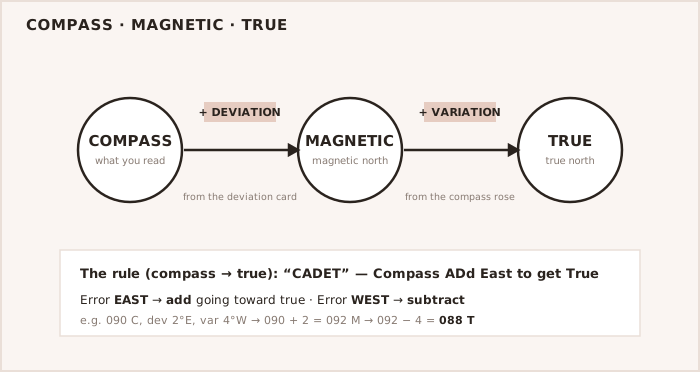
The OOW must move fluently in both directions. Going from compass to true you apply deviation first (to reach magnetic) then variation (to reach true); going from true to compass you work the other way. The sign rule is the memory hook 'error east, compass least; error west, compass best' — an easterly error means the true value is greater than the compass value, so you add easterly errors when converting toward true and subtract westerly ones. A worked example: compass heading 090, deviation 2 E, variation 4 W gives 090 + 2 = 092 magnetic, then 092 − 4 = 088 true.
TIP — One rule, applied consistently Decide your direction of travel (compass→true or true→compass) before you touch the numbers, then apply 'east add, west subtract' when heading toward true. Reverse the signs going the other way. Most compass-error mistakes are sign slips, not arithmetic.
The gyro compass and gyro error
A gyro compass finds true north mechanically and is unaffected by the ship's magnetism, which is why it drives the radar, ECDIS and autopilot. It is not perfect, though: it carries a small gyro error (a steady easterly or westerly offset, sometimes needing a latitude and speed correction). Gyro error is applied exactly like compass error to turn gyro bearings into true bearings, and it is checked the same way — by comparing a gyro bearing of a transit or a celestial body against its known true bearing. A prudent OOW checks the gyro at least once a watch and logs the error.
WARNING — Check the compass every watch An undetected gyro or compass error puts every plotted position and every course order out by the same amount. Check against a transit or azimuth at least once a watch and whenever you doubt the heading.