
Conduct in any condition of visibility
The International Regulations for Preventing Collisions at Sea (IRPCS / COLREGs) apply to all vessels. Rules 4 to 8 apply in any visibility: keep a proper lookout (Rule 5); proceed at a safe speed appropriate to visibility, traffic, manoeuvrability and the state of the sea (Rule 6); use all available means, including radar, to determine whether a risk of collision exists, and never assume on scanty information (Rule 7); and take action to avoid collision that is positive, made in ample time, and large enough to be readily apparent to the other vessel, checking that it works (Rule 8).
Conduct of vessels in sight of one another
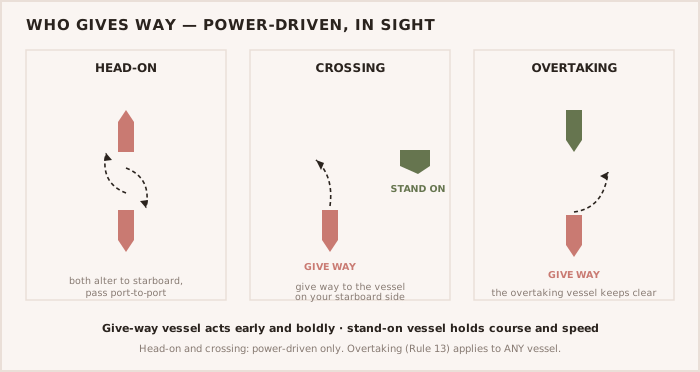
| Situation (power-driven) | Give-way vessel | Action |
|---|---|---|
| Head-on | Both | Each alters to starboard to pass port to port |
| Crossing | The vessel with the other on her own starboard side | Alter to starboard; do not cross ahead |
| Overtaking | The overtaking vessel | Keep clear until finally past and clear |
| The three power-driven encounters (Rules 13-15). |
The give-way vessel (Rule 16) takes early and substantial action to keep well clear. The stand-on vessel (Rule 17) holds her course and speed, but may take action if it becomes clear the give-way vessel is not acting, and must act when collision cannot be avoided by the give-way vessel alone — and she must not alter to port for a vessel crossing on her own port side. Rule 18 sets the pecking order between vessels: a power-driven vessel keeps out of the way of a vessel not under command, one restricted in her ability to manoeuvre, one constrained by draught, a fishing vessel, and a sailing vessel.
WARNING — Early, large and to starboard In a crossing or head-on situation the examiner wants an alteration to starboard that is early and big enough to be unmistakable on the other ship's radar and by eye — never a small nudge, and never (in these cases) a turn to port.
NOTE — Restricted visibility is different In or near restricted visibility, Rule 19 governs and there is no stand-on vessel; both proceed at a safe speed, and a vessel must avoid an alteration to port for a vessel forward of the beam (other than one being overtaken) and toward a vessel abeam or abaft the beam.