
The language of the hull
| Term | Meaning |
|---|---|
| LOA / LBP | Length overall / length between perpendiculars |
| Beam / draught | Breadth / depth of the keel below the waterline |
| Freeboard | Height of the deck edge above the waterline |
| Camber / sheer / flare | Transverse deck curve / fore-and-aft deck rise / outward hull curve above the waterline |
| Displacement / GT | Weight of water displaced / a volumetric measure of enclosed space |
| Core dimension and form terms. |
These terms are not academic: freeboard governs reserve buoyancy, flare throws spray clear and adds buoyancy forward, and displacement is the actual weight of the ship, distinct from gross tonnage which is a measure of volume used for regulation and charging. Knowing draught and beam against the chart and the berth is a daily safety calculation.
Stresses on the hull
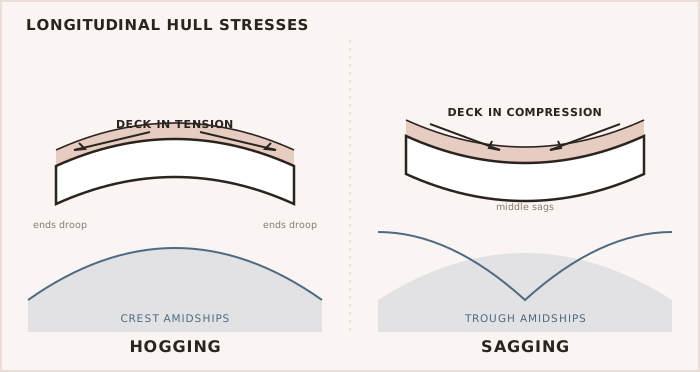
A hull is loaded in several ways at once. The two great longitudinal stresses are hogging, when a wave crest amidships lifts the middle and leaves the ends unsupported so the deck goes into tension, and sagging, the reverse, when the ends are supported on two crests and the middle drops into a trough. As waves pass, the hull cycles between the two. Local and transverse stresses include panting, the in-and-out flexing of the bow plating from fluctuating water pressure; pounding or slamming, the heavy blows on the forefoot when it emerges and re-enters in a seaway; racking, the tendency to distort transversely when rolling; and vibration from the propeller and machinery.
NOTE — Discontinuities concentrate stress Sharp corners at hatches, changes of section and poorly finished welds concentrate stress and are where fatigue cracks begin. This is why hatch corners are rounded and why the OOW reports any crack found on rounds.