
Why tides matter
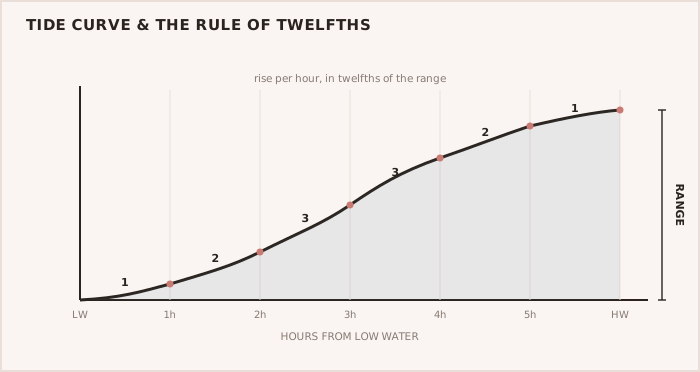
Chart datum is set near the lowest astronomical tide, so there is almost always more water than the chart shows — but a drying patch, marked as a height above datum and usually underlined, may or may not be covered. To be sure of enough water the skipper must be able to work out the height of tide at a given time, and conversely the time at which a required depth appears. Spring tides, near new and full moon, have the largest range; neap tides, near the quarters, the smallest.
Height of tide by the Rule of Twelfths (standard port)
- From the tide tables note the times and heights of the high and low water either side of your time.
- Work out the range: high-water height minus low-water height.
- The tide rises (or falls) 1/12, 2/12, 3/12, 3/12, 2/12, 1/12 of the range in each successive hour.
- Add the twelfths risen to the low-water height (or subtract those fallen from high water) for the height at your time.
- Real depth of water = charted depth + height of tide; clearance under a bridge = charted clearance minus the height of tide.
WARNING — Springs and neaps change everything The range at springs can be several times the range at neaps. Always use the correct day's predictions and, at a secondary port, apply the differences for the day — a slip here is how boats end up aground.
TIP — The Rule of Twelfths is a quick estimate The twelfths rule assumes a smooth six-hour tide and is close enough for planning at a standard port. For precision, or where the curve is unusual, use the tidal curve diagram in the almanac.