
Entry & progression
These are the systems that 46 CFR 11.323(b)(2) allows an STCW endorsement to be restricted away from: auxiliary boilers, waste-heat boilers, distilling plants, oily water separators, sewage treatment plants. If your ship has them, learn them. If it does not, know what your ticket may be missing.
Boilers
A boiler is a pressure vessel holding water above its atmospheric boiling point. The energy stored in it is enormous and the failure modes are violent. Two things matter above all others:
- Water level. Low water uncovers heating surfaces, which overheat and fail. Gauge glasses must be blown down and proved on a routine, and the low-water cut-outs must be tested, not assumed.
- Water treatment. Scale insulates the heating surface and destroys it; the wrong chemistry corrodes it. Test, dose and log.
Safety valves are not decoration, and they are not yours to adjust. Their setting and testing belong to the survey regime.
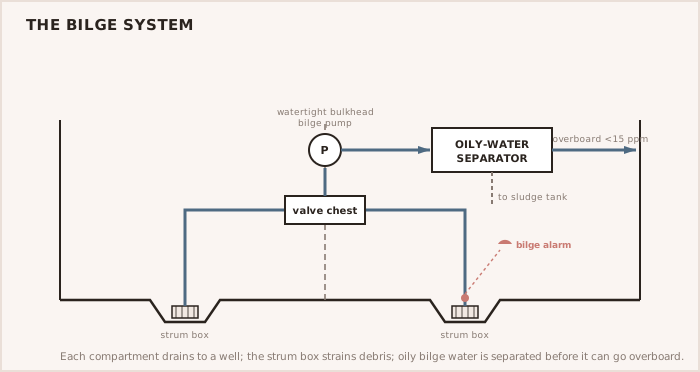
The oily water separator — the compliance trap
WARNING — This is the system that ends careers The oily water separator, the oil content meter and the Oil Record Book are the most heavily scrutinised items on any vessel. Discharge violations and false Oil Record Book entries have produced criminal prosecutions, personal fines and prison sentences — not only for companies, but for individual engineers.
Never bypass the separator. Never falsify the Oil Record Book. Never sign an entry you did not witness. If you are instructed to do any of these things, that instruction is not one you are obliged to follow — and the person giving it will not be standing next to you afterwards.
Operate the separator as designed. Keep the oil content meter calibrated and functional. Make the Oil Record Book entries contemporaneous and truthful. Where you cannot process waste aboard, land it ashore and keep the receipt.
CAUTION — Discharge limits and record-keeping detail are outside this course The specific discharge criteria, the applicable special areas, and the Oil Record Book entry requirements come from MARPOL as given effect in US law and by the flag state. This course does not state those figures, because they are not in its verified source base. Get them from the vessel's safety management system, from the flag administration, and from the current regulation — not from a training module.
Sewage treatment
A marine sanitation device is a biological process pretending to be a machine. It needs a consistent load, the right chemistry, and a working aeration and disinfection stage. Shock it with detergent, bleach or a sudden change of load and the bugs die — at which point you have a tank of raw sewage and a compliance problem. The discharge rules, again, come from the applicable regulation and not from this course.
Refrigeration and HVAC
- Refrigeration is a food-safety system, and on a yacht it is a guest-experience system as well. It also fails quietly, at the worst possible time, in the warmest possible place.
- Charge and leaks. Refrigerant loss is an operational and an environmental problem. Find leaks — do not simply top up. Refrigerant handling and record-keeping are regulated; check the requirements applicable to your flag and your refrigerant.
- Superheat and subcooling are the diagnostic pair. Learn to read them together: they separate a charge problem from a metering problem from an airflow problem.
- HVAC generates complaints faster than any other machinery aboard. Chilled water, air handlers, filters, condensate. Keep it clean and keep it logged.
Distilling plants and fresh water
Evaporators and reverse-osmosis units make the water everybody aboard drinks. That makes them a public-health system. Watch salinity, watch the disinfection stage, watch the storage tanks, and treat any doubt about potability as a stop-work matter rather than an inconvenience.