
Entry & progression
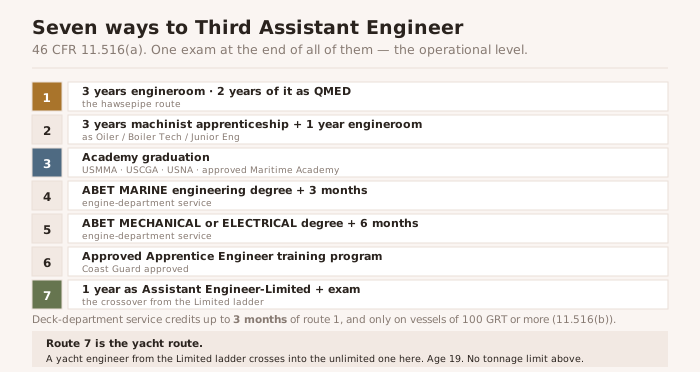
11.516(a)(7): 1 year as Assistant Engineer-Limited + exam = Third Assistant Engineer. 11.512(a)(2): 1 year as Chief Engineer-Limited + exam = FIRST Assistant Engineer — skipping Third and Second entirely. This is the most valuable lesson in the course.
The two crossings
| From | Requirement | To | Section |
|---|---|---|---|
| Assistant Engineer-Limited | 1 year of service on self-propelled vessels + the appropriate examination | Third Assistant Engineer | 11.516(a)(7) |
| Chief Engineer-Limited | 1 year of service + the appropriate examination | First Assistant Engineer | 11.512(a)(2) |
Look hard at the second row. One year as Chief Engineer-Limited, plus the management-level examination, and you arrive at First Assistant Engineer — a grade with no tonnage limit of any kind. You do not pass through Third Assistant Engineer. You do not pass through Second Assistant Engineer. You skip both.
TIP — And then it is very nearly over From First Assistant Engineer, one year of service gets you Chief Engineer — 46 CFR 11.510(a)(1) — and there is no examination for Chief Engineer (11.903(c)(6)). There is no examination for Second Assistant Engineer either (11.903(c)(9)). The whole unlimited ladder carries exactly two professional exams: Third Assistant Engineer (operational level) and First Assistant Engineer (management level). "You test at every rung" is simply false.
Why this is the realistic yacht route
The conventional way to Third Assistant Engineer runs through a maritime academy, or through three years in the engineroom with two of them as a QMED, or through an ABET-accredited engineering degree. Those routes are real and they work. They are also routes that a working yacht engineer — already at sea, already earning — is not realistically going to take.
The Limited ladder is the one that is actually available to somebody building service on the boats they are already on. Get to QMED. Build to Assistant Engineer-Limited. Serve two years on it as an engineer officer, reach Chief Engineer-Limited, serve a year on that, sit the management-level examination — and step onto the unlimited ladder one rung below the top.
But the horsepower wall is still standing
WARNING — The tonnage ceiling lifts. The horsepower ceiling does not lift by itself. First Assistant Engineer has no tonnage limit. It may still carry a propulsion-power limitation computed under 11.503(b) from the service you actually did. And on the STCW side, NVIC 15-14, Enclosure (1), ¶1 requires a Chief or Second Engineer Officer applicant to hold or qualify for a national endorsement for at least 4,000 HP.
A national ticket limited to 2,000 HP will not carry an STCW III/2. The kW ceiling on the STCW side and the HP ceiling on the national side are the same wall in two units. Plan your horsepower service as deliberately as you plan your grades — the removal routes are at 11.503(c).
Where the Limited grades reach on the STCW side
| National endorsement held | Additional service for the STCW endorsement |
|---|---|
| Chief Engineer-Limited | 12 months → STCW Chief Engineer Officer, 3,000 kW / 4,000 HP or more (Table 1 to 11.325(d)) |
| Assistant Engineer-Limited | 12 months → STCW Second Engineer Officer, 3,000 kW / 4,000 HP or more (Table 1 to 11.327(d)) |
Note that Chief Engineer-Limited is one of only four national grades that can reach STCW Chief Engineer Officer at all — the others being Chief Engineer, Chief Engineer-MODU and Chief Engineer-OSV. You cannot get there from First Assistant Engineer. It takes a chief-grade national endorsement. That makes the humble Limited chief ticket more strategically valuable than the far grander-sounding First Assistant.
CAUTION — Confirm the route before you commit years to it These paths are in the regulation, but eligibility for any specific applicant turns on the detail of the service, the examinations already sat, and the limitations carried on the endorsement held. Take your service record to the National Maritime Center and get the route confirmed before you build a decade around it.