
Entry & progression
Entry: L3.1. Progression: on a modern yacht the electrical plant works harder than the mains and fails more often. A blackout at sea is a propulsion, steering and navigation casualty at the same moment.
Load, and the honest number
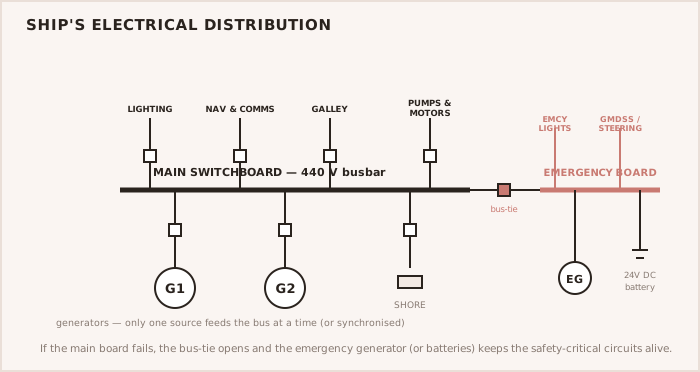
Know your actual load, not the sum of the nameplates. Measure it at anchor with guests aboard, underway, and on the worst afternoon of the season with everything running. Then compare it with what one genset can carry. If the answer is "nearly all of it," you have no redundancy at all — you have a single point of failure with a spare bolted next to it.
And know what happens when a genset is asked for more than it has. Frequency droops, the breaker trips, and everything downstream stops at once. Manage the load before the load manages you: shed the laundry, stage the air-conditioning compressors, and teach the interior crew why — because the fix is behavioural, not electrical.
Blackout — rehearse the recovery
Write the recovery sequence and put it on the switchboard. What starts first. What must be closed before what. Which breakers must be off before you restore, so the plant does not trip again on inrush the second it comes back. What the emergency source feeds and for how long. Then practise it in daylight, alongside, on purpose. The first time you do a blackout recovery must not be the first time you do a blackout recovery.
- Establish what you have lost — propulsion, steering, navigation, lighting, alarms.
- Tell the bridge immediately, in one sentence, and tell them how long you think you need.
- Restore the source. Then restore in a controlled order — never everything at once.
- Find out why before you go back to bed. A blackout with no diagnosed cause is a blackout that will repeat.
Shore power — the yacht's favourite way to hurt itself
The boat leaves a 60 Hz, 208 V country and arrives in a 50 Hz, 400 V one. Getting that wrong damages motors, drives and compressors expensively and slowly. Know exactly what your boat accepts, what her converter or transformer does, what the phase rotation must be, and what your shore cable and its connector are actually rated for. Check the frequency and the voltage before you close the breaker, every time, in every marina. The one time you assume is the time the marina is wired differently.
Earth faults and the floating system
Many boats run insulated distribution with earth-fault monitoring — the lamps or the meter on the switchboard that nobody looks at. A single earth fault does not stop the boat. It removes your protection, and the second fault is the one that kills someone or starts a fire. Look at the monitor every day. When the fault appears, hunt it down by systematic isolation, one circuit at a time, and write down what you eliminated — because you will not find it in one session, and next week you will not remember where you got to.
DC, batteries and the boring failures
Start batteries that will not crank a genset in an emergency are a classic, avoidable embarrassment. Load-test them; do not trust a resting voltage. Check charger settings against the battery chemistry actually installed — someone changed them and did not change the settings. Clean terminals, tight lugs, correct fusing at the source. Most DC failures are a connection, not a component.
CAUTION — High voltage is a different competence, and it is treated as one The CFR itself names high-voltage power systems as a distinct item of approved professional training for the Electro-technical Officer (46 CFR 11.335(a)(4)). If your vessel has an HV system, do not approach it on general electrical confidence. Get the specific training, follow the vessel's HV safe-working procedures, and do not work alone.