
Entry & progression
Entry: L3.3. Progression: nothing in this course carries more personal risk than this lesson. Engineers do not usually go to prison for polluting. They go to prison for what they wrote in the book.
That is not a maintenance log. It is a statement of fact, signed by you, about things the state cares about very much and can very often check.
Why this is the document that ruins people
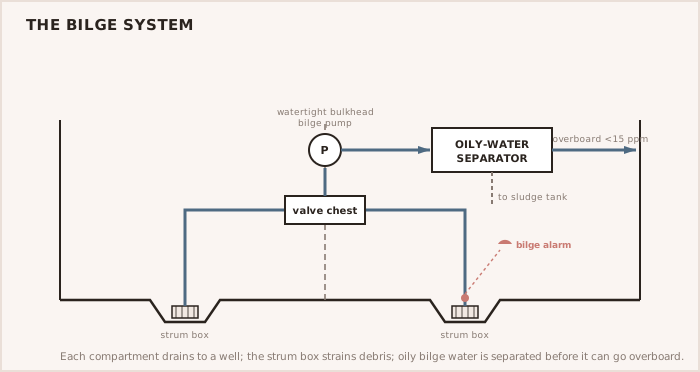
The pattern repeats with grim consistency. A discharge happens — sometimes deliberate, sometimes an equipment failure, sometimes a decision made by someone senior. The discharge itself may be a fine, and the company may pay it. Then the book is written to say something else. And that — the false entry, the book handed to an inspector as true, the story maintained in an interview — is what turns an environmental problem into a criminal one, with the name of whoever signed the page at the top of it.
WARNING — The person who signs the book is the person in the dock If you are instructed to record something that did not happen, or to omit something that did, that instruction is the crime and you are the one being asked to commit it — whoever gave it and however senior they are. Do not sign a book you did not keep.
The standard, and it is simple
- If it happened, write it. Every operation, at the time, in ink, dated and signed.
- If it did not happen, do not write it. No back-filling, no tidying, no "catching up" at the end of a season.
- Keep the evidence. Receipts and manifests for every drop of sludge, waste oil and bilge water landed ashore — proof the oil went where the book says it went.
- Never correct by erasing. Correct visibly, so the record shows what was written and what it became. An erasure is what a prosecutor calls consciousness of guilt.
- If you are unsure whether an operation is recordable, record it. Nobody was ever prosecuted for writing down too much.
The corner people get pushed into
It arrives quietly. The separator has been unreliable for a month. The sludge tank is filling. The next port is expensive, or landing it takes two days the programme has not got. Nobody says anything illegal out loud. The pressure is simply that the tank is full and the boat must move.
That corner is where every one of these cases begins, and the way out of it is not a valve. It is escalation, in writing, early. Tell the captain the tank capacity, the rate it is filling, the date it becomes a problem, and what it costs to deal with properly — in an email, weeks out, before anyone is desperate. An engineer who raises it while it is still a scheduling question is doing the job. One who raises it on the night is negotiating with a man who has run out of options, and nobody wins that conversation.
Keep the machine honest
All of this gets easier if the equipment works. Maintain the separator, keep the monitor and its alarm functional and calibrated, never bypass anything, and never leave a flange, hose or fitting rigged in a way that could be a bypass. Suspicion attaches to geometry. An inspector who finds a hose that does not belong will not be reassured by an explanation.
CAUTION — This lesson deliberately cites no pollution-regulation numbers — and you must go and get them The specific requirements — which vessels must carry an Oil Record Book, which operations are recordable, discharge criteria and oil-content limits, equipment standards, retention periods and penalties — sit in MARPOL and its national implementing law, outside the verified source base for this course, and they turn on flag, tonnage and operating area. Nothing here is a substitute for them. Get the rules that apply from your flag administration, the vessel's SMS and the Coast Guard — never from a colleague's memory of a previous boat.