
Entry & progression
Entry: Modules 2 and 3. Progression: this is why the Coast Guard makes every engineer hold Advanced Firefighting (11.201(h)(2)(iv)) — including the DDE 1,000 HP. You are one person. Your first job in a casualty is not to fix it.
WARNING — Raise the alarm first. Every time. You are one person in a space nobody else understands. If you go quiet, the boat loses its engineer and its information. Alarm first, then act. Ninety seconds spent fighting something alone, unannounced, is ninety seconds the master did not have to slow the boat, turn her, muster the crew or call for help. There is no fault so small that it is worth being the only person who knows about it.
Fire in the machinery space
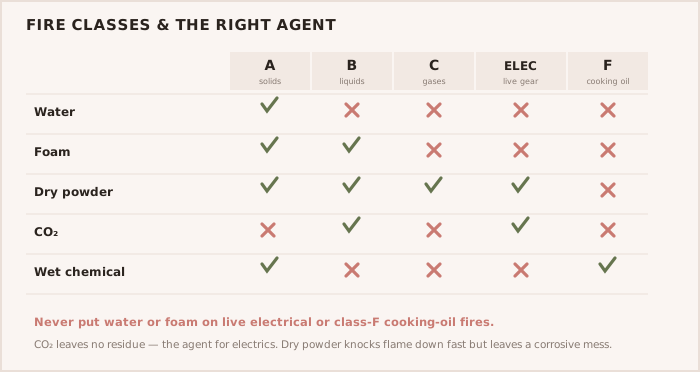
A machinery-space fire goes from survivable to unsurvivable faster than anywhere else on the boat: a confined space, fuel under pressure, hot metal, forced air. If it is not out in the first moments with a portable, the answer is the fixed system — and the fixed system only works in a sealed space.
- Raise the alarm. Machinery-space fire, location, what is burning.
- Shut down and isolate: engines, generators, fuel supply and transfer, ventilation and blowers.
- Close the boundary: dampers, flaps, doors, hatches. Every opening is the fire's air supply.
- Account for every person in or near the space. Nothing is released until that is certain.
- Release the fixed system on the master's order, per the boat's procedure.
- Cool the boundaries and do not re-enter. Re-flash from opening a space early has killed people. Re-entry only with BA, a charged hose and a plan.
Two hard truths. The deck crew are your fire party — how well they hold the boundary is a direct result of whether you trained them when nothing was happening. And the fixed system is a one-shot decision. Know what triggers it, what must be closed first, and who gives the order — before the day.
Flooding
Find it, stop it, then pump it — in that order, because a pump fighting an open hole is a delaying tactic. Most small-vessel flooding is not a hull breach. It is a hose, a clamp, a seacock, a shaft seal, a strainer lid or a through-hull, which means it can usually be stopped at a valve — if you know where the valves are and can reach them in the dark, underwater, by feel.
Report the rate, not the fact: "flooding aft, rising, I think it's the shaft seal, I need two minutes and a hand" gives the master a decision. "There's water in the engine room" gives him nothing. And say early if you are losing — a tow arranged twenty minutes ago is a different day from one arranged now.
Loss of propulsion
The moment the shaft stops, a clock starts, and its unit is sea room. Before you open anything, tell the bridge how long you need and how confident you are. That sentence lets the master anchor, drift, call a tow or turn off a lee shore while there is still water to do it in. Then work the failure logically — fuel, air, water, electrics, control — and do not disturb three things at once, or you will not know which one worked.
Afterwards
When the boat is safe: write it down while it is fresh, preserve what failed rather than throwing the part over the side, and report it through the master. The record you make in the hour after a casualty is the one that gets read for years.
CAUTION — Marine casualty reporting is outside this course's source material What must be reported to the Coast Guard, on what form, within what period, and what must be preserved for an investigation is governed by regulation and by the vessel's safety management system — none of which is drawn from this course's verified source base. Do not guess at it. Get the reporting requirements from the SMS, the company DPA and the OCMI, and have them understood before you need them.