
Entry & progression
The national credential and the STCW endorsement are two different things, and a vessel can require one without the other. 46 CFR 15.1103(a) is the switch. It has an OR in it, and the OR is the whole lesson.
46 CFR 15.1103(a), verbatim: "Onboard a seagoing vessel of 500 GT or more, driven by main propulsion machinery of 1,000 HP/750 kW propulsion power or more, or on an international voyage beyond the boundary line… no person may serve in a position requiring a person to hold an STCW endorsement… unless the person serving holds an appropriate, valid STCW endorsement."
Take the sentence apart
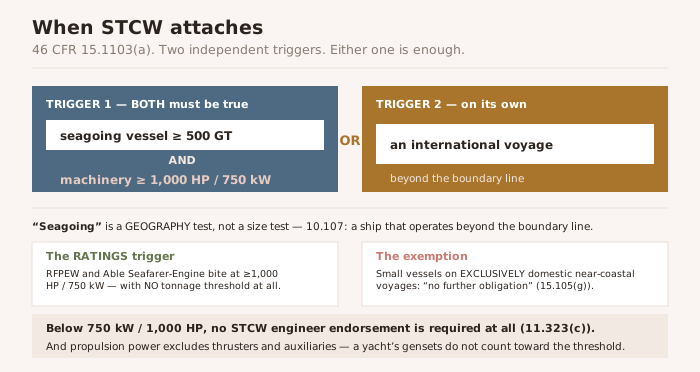
There are two triggers joined by or. The first is a size-and-power test: seagoing, 500 GT or more, and driven by main propulsion machinery of 1,000 HP / 750 kW or more. Both halves of that first trigger must be true together.
The second trigger stands alone: an international voyage beyond the boundary line. That one has no tonnage attached to it in the text. A vessel that goes foreign has crossed into the STCW regime by virtue of where she went.
NOTE — 'Seagoing' is geography, not size 46 CFR 10.107: a seagoing vessel is "a ship that operates beyond the boundary line specified in part 7." It is a question about where the vessel goes, not about how big she is. A 3,000 GT yacht that never leaves inland waters is not a seagoing vessel. A far smaller one that crosses the Boundary Line is.
The ratings trigger — and it has no tonnage at all
For the ratings — Rating Forming Part of an Engineering Watch and Able Seafarer-Engine — 15.1103 bites at 1,000 HP / 750 kW or more with no GT threshold in the trigger. The propulsion-power test stands alone on the ratings side. This is easy to miss and it catches small, powerful vessels.
The exemption — 'no further obligation'
46 CFR 15.105(g) and 11.301(g) deem certain vessels compliant, with the phrase "no further obligation". The class is small vessels engaged exclusively on domestic, near-coastal voyages:
- Subchapter T and K small passenger vessels
- Vessels of less than 200 GRT (other than those under Subchapter H)
- Uninspected passenger vessels
Read the qualifier before you celebrate. Exclusively domestic, near-coastal. The moment a vessel makes an international voyage beyond the boundary line, she has stepped out of the exemption and into 15.1103(a) — by the second trigger, regardless of her tonnage.
WARNING — A yacht that crosses to the Bahamas is not on a domestic voyage This is where the exemption evaporates for most of the fleet. "Exclusively domestic" means exactly that. A yacht that runs the US coast all season and then goes foreign once has, on that voyage, satisfied the second limb of 15.1103(a). The exemption is not an attribute of the vessel — it is an attribute of what she does.
CAUTION — STCW attaching to the vessel and to you are two questions 15.1103 tells you when a vessel requires STCW-endorsed personnel. What you must hold — and which national endorsement carries which STCW endorsement — is the subject of the other courses in this pathway. Confirm both against the current NMC guidance for your endorsement.