
Entry & progression
Exam module: Q161. The duty to assist is a legal one, not a courtesy.
The duty to assist
A master is obliged to render assistance to any person in danger at sea, so far as it can be done without serious danger to their own vessel and the people aboard her. That last clause is real: you are not required to hazard your own passengers. But you are required to weigh it honestly, and to say so if you decline.
On hearing a distress call
Responding to a Mayday
- Listen. Do not transmit immediately. A shore station or a closer vessel may already be answering, and stepping on the casualty's transmission helps nobody.
- Write it down — position, nature, persons aboard, vessel description.
- If no one answers, acknowledge: 'Mayday, [their name], this is [your name], received Mayday.'
- Report your position, speed and ETA to the casualty, and to the Coast Guard.
- Proceed, if you can do so safely, and post extra lookouts.
- Take direction from the Coast Guard or the On-Scene Coordinator. A coordinated search beats six boats doing their own thing.
Searching
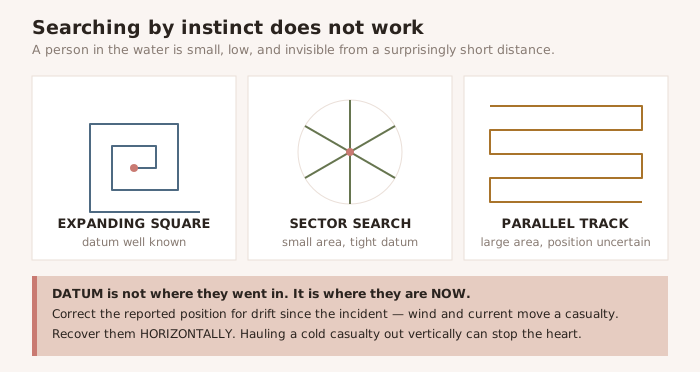
A person in the water is very small, very low, and invisible from a surprisingly short distance — especially in any sea. Search patterns exist because searching by instinct does not work.
- Expanding square — start at the datum and work outward in a growing square. Best when the position is fairly well known.
- Sector search — repeated passes through a central datum from different directions. Good for a small area with a well-defined datum.
- Parallel track — long parallel legs across a larger area. Used when the position is uncertain and the area is big.
Datum is the estimated position of the casualty, corrected for the time elapsed and the drift since. A person in the water moves with wind and current, and after an hour they are not where they went in. Work out the drift; do not search the position they were reported at.
WARNING — Hypothermia is the clock you are racing In cold water, a casualty's useful survival time is measured in tens of minutes, not hours — and they lose the ability to help themselves long before they lose consciousness. Speed matters more than elegance. A rough recovery that happens is worth more than a perfect one that arrives late.
Recovering a casualty
Keep them horizontal if you possibly can. A body that has been cold in the water for a long time has blood pooled in the core; hauling them out vertically can drop their blood pressure sharply and stop the heart. It is called circum-rescue collapse, and it kills people who have already been saved.
Handle gently, get them dry, insulate them, and get help. Do not rub them, do not give alcohol, and do not assume that because they are talking, they are safe.