
Entry & progression
Exam module: Q100 — Rules of the Road, Inland and International. 50 questions, 90% pass mark, and no references permitted. This is the module that fails candidates.
Two sets of rules, one boundary
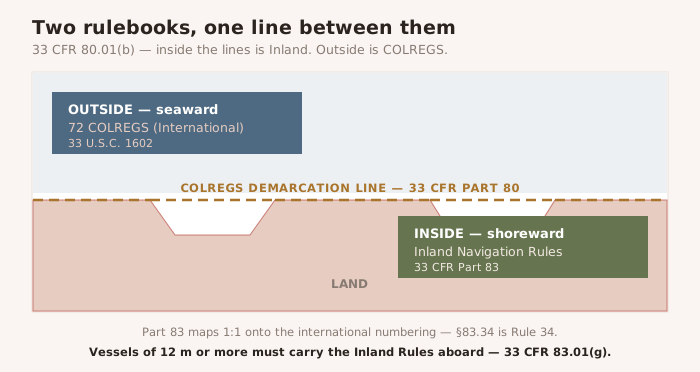
US waters are governed by two rulebooks, and which one applies depends on where you are floating.
| International | Inland | |
|---|---|---|
| What | 72 COLREGS | Inland Navigation Rules |
| Authority | 33 U.S.C. 1602 — proclaimed by the President, effective as if enacted by statute | 33 CFR Part 83, issued under 33 U.S.C. 2071 |
| Where | Seaward of the demarcation lines | Shoreward of them |
| In force since | 15 July 1977 | Recodified into Part 83 in 2014 |
The boundary is drawn by the COLREGS Demarcation Lines at 33 CFR Part 80. Section 80.01(b) could not be plainer: "The waters inside of the lines are Inland Rules waters. The waters outside the lines are COLREGS waters."
How the Inland Rules are numbered
33 CFR Part 83 maps one-to-one onto the international rule numbers. Section 83.34 is Rule 34. Section 83.15 is Rule 15. Once you see that, the two books stop being two books and become one book with a set of marked differences — which is exactly how the exam treats them.
- Part 80 — demarcation lines (where the boundary runs).
- Part 83 — the Inland Rules themselves, §§ 83.01–83.38.
- Parts 84, 86, 87, 88 — Annexes I, III, IV and V. (Part 85, the Annex II slot, is reserved.)
- Part 89 — implementing rules, including which waters Inland Rules 9(a)(ii), 14(d) and 15(b) apply to.
- Part 90 — interpretative rules.
TIP — Learn the differences, not the rules twice The two rulebooks are largely identical. Roughly a dozen provisions genuinely differ, and the exam lives in those dozen. Learn the common text once, then learn the deltas cold. L2.6 is the delta list.
A rule that is Inland-only, and easy marks
33 CFR 83.01(g): a self-propelled vessel of 12 metres or more must carry a copy of the Inland Rules on board. There is no international equivalent. It is the kind of small, precise, uniquely-Inland fact this module is built out of.
How the rules are organised
Both books follow the same five-part structure, and knowing which part a rule lives in will often tell you the answer before you have recalled the rule itself:
| Part | Rules | What it governs |
|---|---|---|
| A — General | 1–3 | Application, responsibility, definitions |
| B — Steering and Sailing | 4–19 | Conduct in any visibility, in sight of one another, and in restricted visibility |
| C — Lights and Shapes | 20–31 | What you show, and what it means |
| D — Sound and Light Signals | 32–37 | Manoeuvring, warning, restricted visibility, distress |
| E — Exemptions | 38 | Grandfathering for existing vessels |
Part B divides again, and this is the division that decides which rules bite. Rules 4–10 apply in any condition of visibility. Rules 11–18 apply only when vessels are in sight of one another. Rule 19 applies only in restricted visibility — and when it applies, the give-way and stand-on rules of Section II do not. In fog, nobody stands on.
Rule 2 — the rule that outranks the rules
Rule 2 is short, and it is the one a court will quote back at you. Nothing in the Rules exonerates any vessel from the consequences of neglect of any precaution which the ordinary practice of seamen may require. And Rule 2(b) permits — requires — a departure from the Rules where necessary to avoid immediate danger.
You may break any rule in the book to avoid a collision. You may not break one and call it compliance. That is the whole of Rule 2, and it is why "I was the stand-on vessel" has never once been a complete defence.