
Entry & progression
Exam module: Q100. Rules 11–18. The core of the module, and the core of watchkeeping.
Head-on — Rule 14
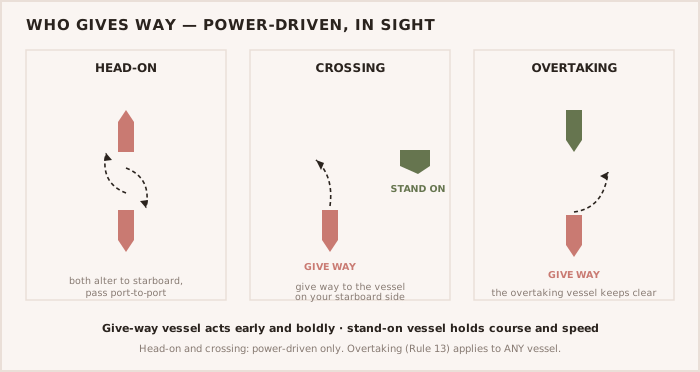
When two power-driven vessels are meeting on reciprocal or nearly reciprocal courses so as to involve risk of collision, each shall alter course to starboard so that each passes on the port side of the other. Neither is the give-way vessel; both act.
The rule tells you how to recognise it: by night you see both sidelights and the masthead lights in a line or nearly in a line. When in doubt, assume it exists and act accordingly.
Crossing — Rule 15
When two power-driven vessels are crossing so as to involve risk of collision, the vessel which has the other on her own starboard side shall keep out of the way and shall, if the circumstances admit, avoid crossing ahead of the other vessel.
Other vessel on your starboard: you give way. Other vessel on your port: you stand on.
Overtaking — Rule 13
An overtaking vessel keeps out of the way of the vessel being overtaken. Overtaking means coming up from a direction more than 22.5 degrees abaft the beam — at night, the position from which you can see only the sternlight and neither sidelight.
Rule 13 overrides everything in the crossing and head-on rules. And it does not let go: any subsequent alteration of bearing between the two vessels shall not make the overtaking vessel a crossing vessel or relieve her of the duty to keep clear until she is finally past and clear.
WARNING — When in doubt, you are overtaking Rule 13(c): if a vessel is in any doubt as to whether she is overtaking, she shall assume that she is and act accordingly. There is no equivalent presumption in your favour. Doubt always resolves against the vessel coming up from astern.
Rule 16 and Rule 17 — the two sides of the same coin
| Rule 16 — the give-way vessel | Rule 17 — the stand-on vessel |
|---|---|
| Shall, so far as possible, take early and substantial action to keep well clear. | Shall keep her course and speed. |
| May take action as soon as it becomes apparent the give-way vessel is not acting. | |
| Shall take action when collision cannot be avoided by the give-way vessel's action alone. | |
| If altering course, shall not alter to port for a vessel on her own port side. |
Rule 17 is the one people get wrong. Standing on is a duty, not a licence — and the moment it becomes clear the other vessel is doing nothing, the stand-on vessel's obligation flips from holding course to avoiding collision. Waiting to be run down while technically in the right is not a defence.
Rule 18 — the pecking order
Except where Rules 9, 10 and 13 otherwise require, a power-driven vessel underway keeps out of the way of: a vessel not under command; a vessel restricted in her ability to manoeuvre; a vessel engaged in fishing; a sailing vessel.
Note what that means for an OUPV under power: you are at the bottom of that list. Note also what it does not say — a vessel constrained by her draught appears in the International Rule 18(d) and is Reserved inland, because the Inland Rules have no such vessel at all.