
Entry & progression
Exam module: Q100. This is the revision lesson. Every item below is a genuine difference between the two rulebooks, verified against 33 CFR Part 83 and the International Rules.
Steering and sailing
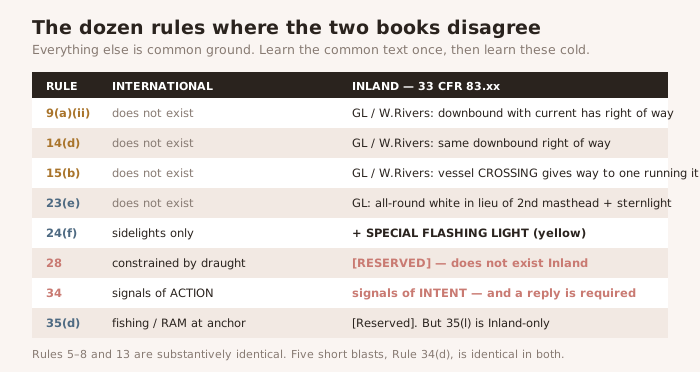
| Rule | International | Inland (33 CFR 83.xx) |
|---|---|---|
| 9(a)(ii) | Does not exist | On the Great Lakes, Western Rivers or specified waters, a power-driven vessel proceeding downbound with a following current has right-of-way over an upbound vessel, proposes the manner and place of passage, and initiates the signals |
| 9(d) | The vessel crossing may use the danger signal if in doubt | Must use it |
| 14(d) | Does not exist — International Rule 14 ends at (c) | Same downbound/following-current right-of-way as 9(a)(ii) |
| 15(b) | Does not exist | On the Great Lakes, Western Rivers or specified waters, a power-driven vessel crossing a river shall keep out of the way of a power-driven vessel ascending or descending the river |
WARNING — Inland Rule 15(b) is not about the current It is widely misremembered as a right-of-way for vessels descending with the current. It is not. 15(b) says a vessel CROSSING a river gives way to a vessel running the river in EITHER direction — ascending or descending. The following-current right-of-way lives in 9(a)(ii) and 14(d). Confusing the three is one of the most reliable ways to lose marks in this module.
Lights and shapes
| Rule | International | Inland |
|---|---|---|
| 23(d)(ii) | Vessel under 7 m with max speed ≤ 7 kt: all-round white alone, sidelights if practicable | No equivalent |
| 23(e) | Does not exist | On the Great Lakes, a power-driven vessel may carry an all-round white light in lieu of the second masthead light and sternlight |
| 24(f) | A vessel pushed ahead shows sidelights only | A vessel pushed ahead or towed alongside shows sidelights and a special flashing light (yellow, 50–70 flashes per minute, 180°–225° arc) |
| 24(c)(iii) | A vessel pushing ahead or towing alongside shows a sternlight | Shows two towing lights in a vertical line |
| 24(j) | Does not exist | On the Western Rivers, a vessel pushing ahead or towing alongside shows sidelights and two towing lights — and no masthead lights |
| 28 | Vessel constrained by her draught: three all-round red lights or a cylinder | [Reserved] — does not exist inland |
The special flashing light is the classic exam trap. It is an Inland light, it belongs to Rule 24, and it is defined in Rule 21(g). It has nothing to do with Rule 23, and it has no international equivalent whatsoever.
Sound signals
- Rule 34 — the whole intent-versus-action architecture, plus the half-mile trigger, the agreement requirement, the yellow/2-mile light option, the leaving-berth blast (34(g)) and the radiotelephone provision (34(h)). See L2.5.
- Rule 35(c) — International includes a vessel constrained by her draught in the one-prolonged-plus-two-short group. Inland cannot, because no such vessel exists; Inland instead specifies RAM and fishing vessels whether underway or at anchor.
- Rule 35(d) — International: a fishing vessel or RAM vessel at anchor sounds the 35(c) signal instead of the anchor signal. Inland: [Reserved].
- Rule 35(l) — Inland only: vessels under 20 m, and barges, canal boats, scows and other nondescript craft, need not sound the anchor signal in a Coast Guard-designated special anchorage area.
Miscellaneous
- 33 CFR 83.01(g) — Inland only: self-propelled vessels of 12 m or more must carry a copy of the Inland Rules aboard.
- Rule 14(a) — the Inland text opens with the words "Unless otherwise agreed"; the International text does not.
- Annex V (33 CFR Part 88) — Pilot Rules — a US-only annex with no international equivalent.
Learn this table, and the module stops being two exams and becomes one. Nearly everything else in Rules of the Road is common ground.