
Entry & progression
Exam module: Q100. Rules 32–37. If you learn one inland/international difference, learn Rule 34. It is the most heavily examined delta in the module.
Rule 34 — international: signals of action
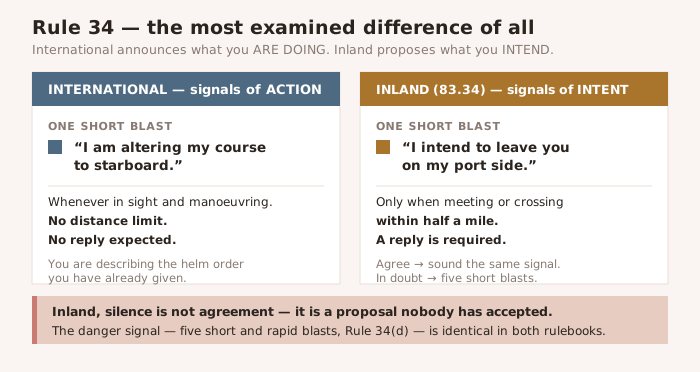
When vessels are in sight of one another, a power-driven vessel underway, when manoeuvring as authorised or required by these Rules, shall indicate that manoeuvre by whistle:
- One short blast — "I am altering my course to starboard."
- Two short blasts — "I am altering my course to port."
- Three short blasts — "I am operating astern propulsion."
You are describing the helm order you have already given. There is no distance limit, and no reply is expected.
Rule 34 — inland: signals of intent, and agreement
33 CFR 83.34(a) applies only when power-driven vessels are in sight of one another and meeting or crossing within half a mile:
- One short blast — "I intend to leave you on my port side."
- Two short blasts — "I intend to leave you on my starboard side."
- Three short blasts — "I am operating astern propulsion."
And then 83.34(a)(ii), which has no international equivalent at all: the vessel hearing the signal shall, if in agreement, sound the same signal and take the steps to effect a safe passing. If she doubts the safety of the proposed manoeuvre, she sounds the danger signal and both vessels take precautionary action until a safe passing agreement is made.
WARNING — Inland, silence is not agreement The inland system is a negotiation. A proposal that goes unanswered has not been accepted, and a proposal you doubt must be met with five short blasts — not with a manoeuvre. Internationally there is nothing to agree to: you announce, and the other vessel acts on her own judgement.
The rest of Rule 34
| International | Inland (33 CFR 83.34) | |
|---|---|---|
| Trigger | Whenever in sight and manoeuvring; no distance limit | Meeting or crossing within half a mile |
| Meaning | Action being taken | Intent — and agreement required |
| Light signals (34(b)) | All-round white, range 5 miles | All-round white or yellow, range 2 miles, synchronised with the whistle |
| Overtaking (34(c)) | Only in a narrow channel. Two prolonged + one short = overtake to starboard. Reply: Morse 'C' (– · – ·) | Whenever in sight. One short = overtake to starboard; two short = to port. Reply: a similar signal |
| Leaving a berth | No such signal | 83.34(g): one prolonged blast — Inland only |
| Radiotelephone | No provision | 83.34(h): VHF agreement relieves the duty to sound the signals — Inland only |
The signals that are the same in both
- Rule 34(d) — the danger or doubt signal: at least five short and rapid blasts. Identical in both rulebooks. Learn it as the one thing you can never get wrong.
- Rule 34(e) — blind bend: one prolonged blast, answered by one prolonged blast from any vessel within hearing around the bend.
- Rule 35 — restricted visibility. One prolonged blast every two minutes for a power-driven vessel making way. One prolonged plus two short for a vessel not under command, restricted in ability to manoeuvre, constrained by draught (international only), sailing, fishing, or towing.
A short blast is about one second. A prolonged blast is four to six. The exam will ask, and the difference between them is the difference between "I intend to leave you to port" and a fog signal.