
Entry & progression
Exam module: Q171. Feeds: Q172 chart plot, where current becomes arithmetic.
The cause
The gravitational pull of the moon, and to a lesser degree the sun, on the water. The moon dominates: it is far smaller than the sun but very much closer, and tidal force falls off with the cube of distance.
| When | What happens | |
|---|---|---|
| Spring tides | New and full moon — sun and moon in line | The two pulls reinforce. Highest highs, lowest lows, greatest range, strongest currents |
| Neap tides | First and last quarter — sun and moon at right angles | The two pulls oppose. Smallest range, weakest currents |
Springs have nothing to do with the season. They occur roughly twice a month, and they are when you will find both the most water over the bar and the least.
Tidal terms
- Range — the difference between high water and low water.
- Height of tide — the vertical distance from chart datum to the water surface at a given moment. Add it to the charted sounding to get actual depth.
- Charted depth — the sounding printed on the chart, measured from chart datum.
- Stand — the period around high or low water when the level barely changes.
- Slack water — the moment the tidal current changes direction. It does not necessarily coincide with high or low water, and assuming it does has put many boats on the ground.
The rule of twelfths
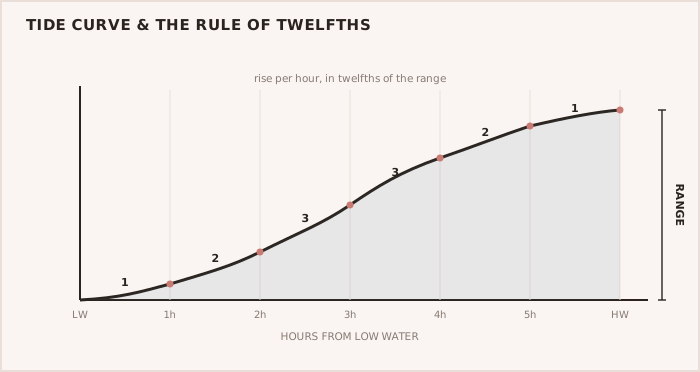
A rough approximation of how the tide rises over six hours, assuming a semi-diurnal tide of even duration. Divide the range into twelfths and apply them hour by hour:
| Hour | 1st | 2nd | 3rd | 4th | 5th | 6th |
|---|---|---|---|---|---|---|
| Twelfths of range | 1 | 2 | 3 | 3 | 2 | 1 |
Half the range moves in the middle two hours. It is an estimate — accurate enough to plan by, never accurate enough to scrape by.
Current: set and drift
- Set — the direction the current is flowing towards. (A wind is named for where it comes from; a current for where it goes to. They are opposite conventions, and the exam knows it.)
- Drift — the speed of the current, in knots.
- Flood — the incoming current, generally towards land or up a river.
- Ebb — the outgoing current.
WARNING — Slack water is not high water The tide can still be rising while the current has already turned, and vice versa. Height of tide comes from the Tide Tables; set and drift come from the Tidal Current Tables. Two different questions, two different books, and no safe way to infer one from the other.