
Entry & progression
Exam module: Q170. The regulatory tail of the job — and the part that ends careers rather than voyages.
Alcohol — the number that matters
| Vessel | Blood alcohol limit |
|---|---|
| Recreational | 0.08 percent |
| Any vessel other than recreational — including your UPV | 0.04 percent |
33 CFR 95.020. Operating a commercial vessel puts you on the 0.04 standard — half the recreational limit, and half the limit for driving a car in most states. The rule also provides that intoxication may be established by observation alone, with no number at all. A blood test is how they prove it; it is not what makes it an offence.
Chemical testing after a serious marine incident
46 CFR 4.06-3 sets the clock, and the two windows are different:
- Alcohol — within 2 hours of the incident. If safety concerns arising from the incident prevent it, then as soon as those are addressed — but never more than 8 hours after.
- Drugs — specimen collection within 32 hours.
You may not consume alcohol for 8 hours after a serious marine incident, or until testing is done. Refusal is recorded and referred for action against your credential. Reaching for a drink after a bad day is the most human thing in the world, and on a commercial vessel after an incident it is the end of your licence.
What must be reported — and the two dollar figures
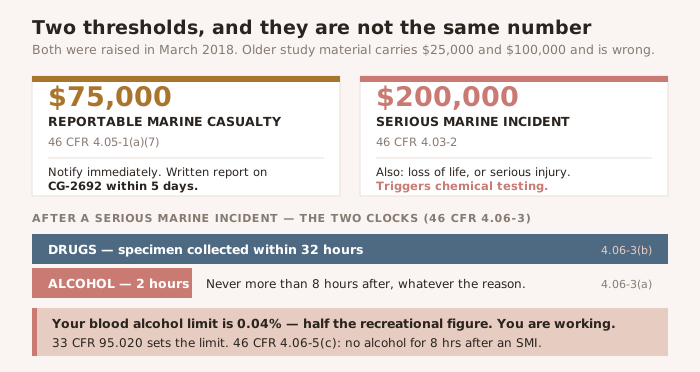
CAUTION — Two thresholds, and they are not the same number $75,000 makes an event a reportable marine casualty (46 CFR 4.05-1(a)(7)). $200,000 makes it a serious marine incident (46 CFR 4.03-2), which is what triggers the chemical testing above. Both figures were raised in March 2018 — older study material carries $25,000 and $100,000 and is simply out of date.
A reportable marine casualty (46 CFR 4.05-1) includes:
- An unintended grounding, or an allision with a bridge.
- Loss of main propulsion, primary steering, or any component that reduces manoeuvrability.
- An occurrence materially and adversely affecting seaworthiness or fitness for service.
- Loss of life.
- Injury requiring professional medical treatment beyond first aid that renders a person in commercial service unfit for routine duties.
- Property damage over $75,000 — including labour and materials to restore the property, but excluding salvage, cleaning, gas-freeing, drydocking and demurrage.
- Significant harm to the environment.
Reporting a casualty
- Notify immediately — the regulation says 'immediately after the addressing of resultant safety concerns' — to the nearest Coast Guard Sector or Marine Inspection Office (46 CFR 4.05-1).
- File the written report on form CG-2692 within 5 days (46 CFR 4.05-10).
- If chemical testing was required, submit CG-2692B with it.
Pollution
- Discharge of oil is prohibited. The 'Discharge of Oil Prohibited' placard (33 CFR 155.450) must be displayed on every vessel 26 feet or more — at least 5 by 8 inches, in the machinery space or at the bilge pump control station.
- The garbage placard (33 CFR 151.59) is required on manned US vessels 26 feet or more, stating the discharge restrictions — including the total prohibition on discharging plastics anywhere.
- Report a spill immediately to the National Response Center: 800-424-8802 (33 CFR 153.203). The duty falls on the person in charge, as soon as they have knowledge of it.
The two placards are the most commonly missing items on an otherwise well-found boat, and the two easiest things in this lesson to fix before anyone comes looking. Buy them, screw them to the bulkhead, and forget about them.