
Entry & progression
Exam module: Q170 — Deck General/Safety. 50 questions, 70% pass mark. Governing regulations: 46 CFR Subchapter C (Parts 24, 25, 26).
Life jackets
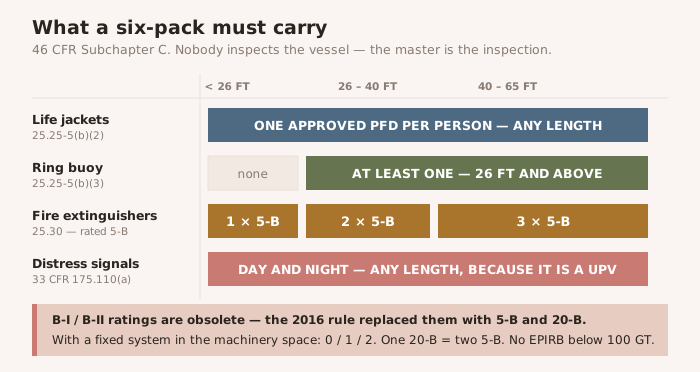
46 CFR 25.25-5(b)(2): a vessel carrying passengers for hire — any length — must carry one approved PFD for every person on board, of an approved type. This is a stricter standard than the one that applies to a recreational boat, and generic wearables will not do.
Ring buoy: 25.25-5(b)(3) requires at least one approved lifebuoy on every vessel 26 feet or longer.
Immersion suits are not required on a UPV under 100 GT. They appear in 25.25-5(c) only as a permitted substitute for a wearable PFD on vessels that are not carrying passengers for hire — which excludes you.
Fire extinguishers — and the rating change that catches people
WARNING — B-I and B-II are obsolete The 2016 rule replaced the old B-I/B-II classification with 5-B / 20-B ratings. If you are revising from an older book — or an older instructor — you are learning a classification the current table no longer uses.
| Vessel length | 5-B extinguishers (no fixed system) | With a fixed system in the machinery space |
|---|---|---|
| Under 16 ft | 1 | 0 |
| 16 to under 26 ft | 1 | 0 |
| 26 to under 40 ft | 2 | 1 |
| 40 to 65 ft | 3 | 2 |
One 20-B may substitute for two 5-B. And note the exemption that does not apply to you: the outboard-powered carve-out for boats under 26 feet in 25.30-20(a)(1) expressly does not extend to vessels carrying passengers for hire.
Visual distress signals
33 CFR 175.110(a): a boat 16 feet or more — or any boat operating as an uninspected passenger vessel — must carry day and night signals. Read that again: the under-16-foot exemption in the recreational rules does not reach a UPV. Length does not save you; the service you are in decides it.
The rest of the list
- Backfire flame control (46 CFR 25.35-1) — on every inboard gasoline engine. Outboards excepted.
- Ventilation (46 CFR 25.40-1) — for gasoline engine and fuel tank compartments, with carve-outs for modern boats built to 33 CFR 183.
- Sound signalling — not in Part 25 at all. It comes from the Navigation Rules: 33 CFR 83.33 requires a whistle at 12 m and a whistle and bell at 20 m. Under 12 m, some other efficient means of making a sound signal.
- Marine sanitation device (33 CFR 159.7) — if there are installed toilet facilities, an operable Type II or III. A Type I is permitted only on vessels of 65 feet or less.
- Safety orientation (46 CFR 26.03-1) — an announcement or placard before getting underway. Emergency checkoff list posted (26.03-2). Charts and publications carried (26.03-4).
- Your credential (46 CFR 26.20-1) — in your possession, produced on demand.
NOTE — No EPIRB on a UPV under 100 GT 46 CFR 25.26-10(a) says so expressly: uninspected passenger vessels of less than 100 gross tons are not required to carry an EPIRB. The requirement begins at 100 GT. Carrying one anyway is excellent seamanship and is not the same as a legal obligation.