
Entry & progression
Exam module: Q170. See also: the Emergency Checkoff List required by 46 CFR 26.03-2 — the regulation assumes you have thought about this before it happens.
Fire
Fire needs three things: fuel, oxygen, heat. Remove any one and it stops. Every firefighting action you take is one of those three removals, and knowing which one you are attempting tells you whether it is working.
Fire aboard
- Raise the alarm. Everyone on deck, life jackets on, muster aft or forward of the fire.
- Manoeuvre. Put the fire downwind — turn the vessel so the wind carries flame and smoke away from the rest of the boat and the people.
- Cut the supply. Shut off fuel and electrics to the compartment. Close hatches and vents to starve it of air.
- Attack it, if it is small and you can do so without being cut off from your escape. Aim at the base of the fire, not the flames.
- Get the call out early. A Mayday you can cancel costs nothing. A Mayday you leave too late may not go at all.
- Prepare to abandon. Life jackets, life raft if carried, EPIRB if carried, flares and handheld VHF to hand.
An engine-space fire is the one that kills boats. Do not open the hatch to look. Opening it feeds the fire the air it has been starved of, and you will lose the compartment and possibly your face. Shut it down, seal it, discharge into it if you can do so without opening it.
Flooding
Flooding
- Find it. You cannot stop water you have not located. Check the obvious first — the shaft seal, the raw-water hose, the skin fittings, the exhaust.
- Stop it or slow it. Softwood plug in a failed skin fitting, hose clamp, anything that reduces the rate.
- Pump. Bilge pumps, buckets. A frightened passenger with a bucket is a real pump.
- Call. Early, with your position.
- Consider shallow water. Beaching a boat you can recover beats sinking one you cannot.
The most useful damage-control tool aboard a small vessel is a softwood plug on a lanyard at every skin fitting. It costs almost nothing and it has saved a great many boats.
Man overboard
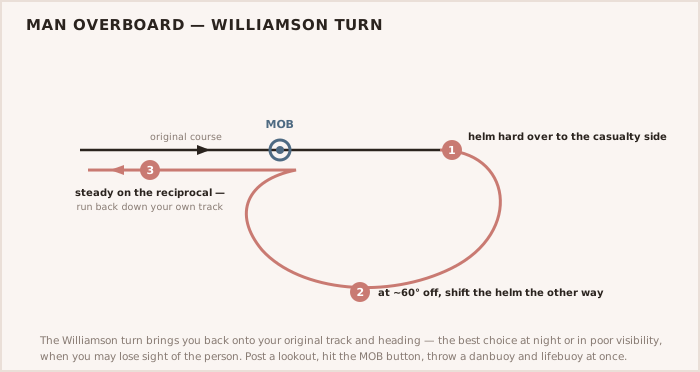
Man overboard
- Shout. "Man overboard, port side." Everyone needs to know immediately.
- Throw buoyancy immediately — the ring buoy, a cushion, anything. It marks the spot even if they never reach it.
- Point. Assign one person to do nothing but point at the casualty and keep pointing. The single most valuable job on the boat, and the one nobody thinks to give.
- Press MOB on the GPS. Note the position and the time.
- Manoeuvre back — a Williamson turn in poor visibility, a direct return in clear water. Approach from downwind, and stop the propeller before the casualty is alongside.
- Recover. Getting a cold, wet, exhausted person up a topsides is far harder than anyone expects. Use a boarding ladder, a halyard, a sling — but plan it before you need it.
- Treat for hypothermia, and keep them horizontal if you can.
WARNING — The propeller The most common way to injure a man overboard is to recover them with the engine engaged. Get the boat stopped and the gear in neutral — ideally the engine off — before anyone is in the water alongside. A recovered casualty with a propeller injury is a far worse problem than a casualty still in the water.