
Entry & progression
Exam module: Q172. Builds on: L3.4 and L4.1.
The vectors
| Vector | Direction | Length | Represents |
|---|---|---|---|
| Course and speed through the water | The course steered | Boat speed × time | What the boat does in still water |
| Set and drift | The set (direction the current flows towards) | Drift × time | What the water does to the boat |
| Course and speed made good | The track actually achieved over the ground | Distance made good | Where you actually went |
Two of these always give you the third. Which two you are given determines which problem you are solving.
The two problems
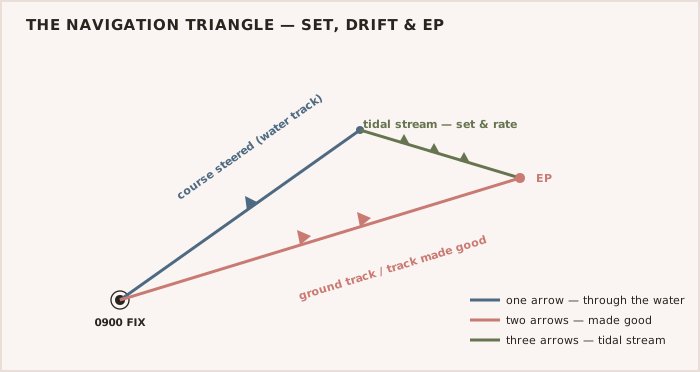
Problem 1 — Find set and drift. You have a DR and a fix for the same time.
Finding set and drift
- Plot the DR position for the time of the fix, using course steered and distance run.
- Plot the fix.
- Draw the vector from the DR to the fix. Its direction is the set.
- Measure its length. Divide by the elapsed time to get the drift in knots.
The direction runs DR to fix, never the reverse. The current moved you from where you would have been to where you actually are.
Problem 2 — Find the course to steer. You know where you want to go and what the current is doing. This is the one you will actually use at sea.
Finding the course to steer to make good a track
- Draw the desired track from your present position through your destination.
- From your present position, lay off the set and drift vector — one hour's worth of current.
- From the end of the current vector, swing an arc with a radius equal to your boat speed (one hour's worth) until it cuts the desired track.
- The line from the end of the current vector to that intersection is the course to steer.
- The distance from your position along the track to the intersection is your speed made good.
TIP — The current vector starts at your position; the boat-speed arc starts at its end That is the step candidates reverse. The current acts on you first — it displaces you — and the boat's own speed is what you have left to fight your way back onto the track. Lay the current off first, always.
Speed made good and ETA
Speed made good is measured along the track, not along the course steered. It is not your boat speed, and against a foul tide it can be startlingly less. ETA follows from distance over speed made good — the arithmetic is trivial and the exam still catches people who used boat speed instead.
A vessel making 6 knots through the water with 2 knots of current against her makes good 4 over the ground, and a two-hour passage becomes three. That is the whole point of the module.