
Entry & progression
Exam module: Q100. Rules 5, 6, 7 and 8 — identical in both rulebooks. Learn them once.
Rule 5 — Lookout
Every vessel shall at all times maintain a proper lookout by sight and hearing, as well as by all available means appropriate in the prevailing circumstances, so as to make a full appraisal of the situation and of the risk of collision.
Three phrases carry the weight. At all times — not when convenient. Sight and hearing — you must be able to hear, which is why a loud stereo has sunk more than one defence. All available means — if you have radar, using it is part of a proper lookout, not an optional extra.
Rule 6 — Safe speed
Every vessel shall at all times proceed at a safe speed so that she can take proper and effective action to avoid collision and be stopped within a distance appropriate to the prevailing circumstances and conditions.
The rule then lists the factors. Know them — they are examined directly.
| All vessels must consider | Vessels with radar must also consider |
|---|---|
| State of visibility | The characteristics, efficiency and limitations of the radar |
| Traffic density | Any constraints imposed by the radar range scale in use |
| Manoeuvrability — stopping distance and turning ability | The effect of sea state, weather and other interference on radar detection |
| At night, backscatter from her own lights | The possibility that small vessels, ice and other floating objects may not be detected |
| State of wind, sea and current, and proximity of hazards | The number, location and movement of vessels detected |
| Draught in relation to available depth of water | The more exact assessment of visibility that radar may give |
Rule 7 — Risk of collision
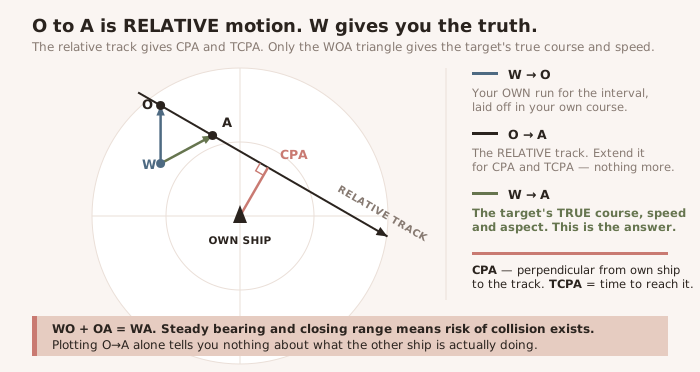
Use all available means. Proper use shall be made of radar if fitted, including long-range scanning and radar plotting. Assumptions shall not be made on the basis of scanty information, especially scanty radar information.
The test itself: risk shall be deemed to exist if the compass bearing of an approaching vessel does not appreciably change. Constant bearing, decreasing range. The rule adds a warning that risk may sometimes exist even with an appreciable bearing change — with a very large vessel, a tow, or at close range.
Rule 8 — Action to avoid collision
- Action shall be positive, made in ample time and with due regard to good seamanship.
- Alterations of course or speed shall be large enough to be readily apparent to another vessel observing visually or by radar. A succession of small alterations should be avoided.
- If there is sufficient sea room, alteration of course alone may be the most effective action.
- Action shall result in passing at a safe distance, and its effectiveness shall be checked until the other vessel is finally past and clear.
- If necessary, slacken speed, stop or reverse.
TIP — 'Readily apparent' is the examinable phrase A ten-degree alteration is not readily apparent on another vessel's radar. The rule wants a change big enough that the other skipper can see what you have done without plotting it. Small and early beats large and late — but large beats small every time.