
Entry & progression
The most important lesson in this course. NVIC 15-14, Enclosure (1), ¶1: a CEO/2EO applicant "must hold or qualify for a national endorsement for at least 4,000 HP." The kW ceiling on the STCW side and the HP ceiling on the national side are the same wall in two units.
The rule
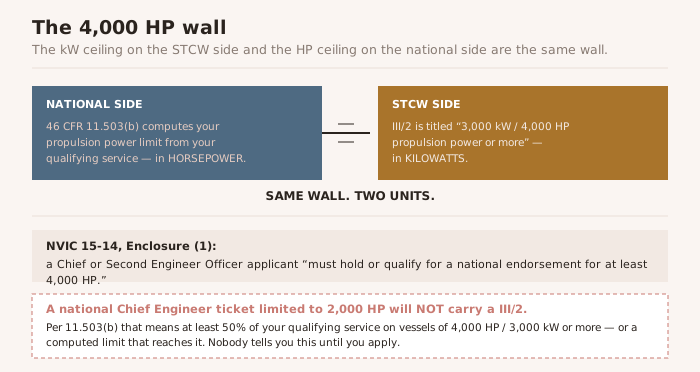
NVIC 15-14, Enclosure (1), ¶1: CEO and 2EO applicants "must hold or qualify for a national endorsement for at least 4,000 HP."
Four thousand horsepower is three thousand kilowatts, which is the band the III/2 covers. The two numbers are the same number. If your national ticket is limited below it, the STCW endorsement has nothing to sit on.
Where the national HP limit comes from — 11.503(b), verbatim
*"When an applicant for an original or raise of grade of an engineer endorsement, other than a DDE, has not obtained at least 50 percent of the required experience on vessels of 4,000 HP / 3,000 kW or more, a propulsion power limitation is placed on the MMC based on the applicant's qualifying experience. The endorsement is limited to the maximum propulsion power on which at least 25 percent of the required experience was obtained, or 150 percent of the maximum propulsion power on which at least 50 percent of the service was obtained, whichever is higher. Limitations are in multiples of 1,000 HP / 750 kW, using the next higher figure when an intermediate horsepower is calculated. When the limitation as calculated equals or exceeds 10,000 HP / 7,500 kW, an unlimited propulsion power endorsement is issued."*
Work it through
Take an engineer whose entire qualifying service is on yachts with mains of 2,000 HP. None of it is on vessels of 4,000 HP or more, so a limitation gets computed:
- 25% rule — the maximum power on which at least 25% of the required experience was obtained: 2,000 HP.
- 50% rule — 150% of the maximum power on which at least 50% of the service was obtained: 150% x 2,000 = 3,000 HP.
- Whichever is higher: 3,000 HP. In multiples of 1,000, that is 3,000 HP.
This engineer's national endorsement will be limited to 3,000 HP. Below 4,000. No STCW III/2 — not for any lack of grade, but because of a sum done on the national side, out of a set of vessels chosen years earlier.
WARNING — A national Chief Engineer ticket limited to 2,000 HP will not carry a III/2 "Chief Engineer" is a grade. The horsepower is a separate number stamped on it. You can be a fully endorsed national chief and still be locked out of the management-level STCW certificate, because the boats you served on were too small.
The size of the engines you serve behind decides the ceiling of your career. Not the courses. The engines.
How to break the wall — 11.503(c)
The limit is not permanent. Service on vessels of 4,000 HP / 3,000 kW or more buys it off:
- 6 months in the highest grade endorsed → all HP limits removed.
- 6 months as an engineer officer in any capacity other than the highest grade → limits removed for that grade, and the next higher grade raised to the HP of the vessel served on.
- 12 months as Oiler or Junior Engineer while holding 3rd A/E or Assistant Engineer-Limited → all HP limits removed on that endorsement.
- 6 months as Oiler or Junior Engineer while holding 2nd A/E → all HP limits removed on the 3rd A/E endorsement.
- 11.503(d): may be granted without further written examination if the Coast Guard considers one unnecessary.
Six months. That is the price, and it is cheap — if you take the berth. Plan a season on a boat with real mains behind it.
CAUTION — The NMC does the sum, not you 11.503(a) computes the limitation from the total shaft propulsion power of every vessel you have served on. The worked example above applies the formula honestly, but your file is a different file. Ask the NMC what horsepower your service supports before you plan around it.