
Entry & progression
11.325(a)(3)(iii) and 11.327: the third approved training item — management of electrical and electronic control equipment. High voltage, automation, and the isolation that keeps people alive.
The engine room stopped being a mechanical space some time ago. On a modern large yacht the plant is a network with engines attached to it: distributed control, redundant PLCs, a power management system deciding on its own which generator to start, and somewhere in the middle of it a switchboard that can kill you before you finish the sentence.
The Coast Guard's answer to that is a management-level training item with a very deliberate word in the title. Not operation of electrical and electronic control equipment. Management of it.
What management means here
- You do not have to be the person with the meter in their hand. You have to be the person who knows whether the person with the meter is competent to hold it.
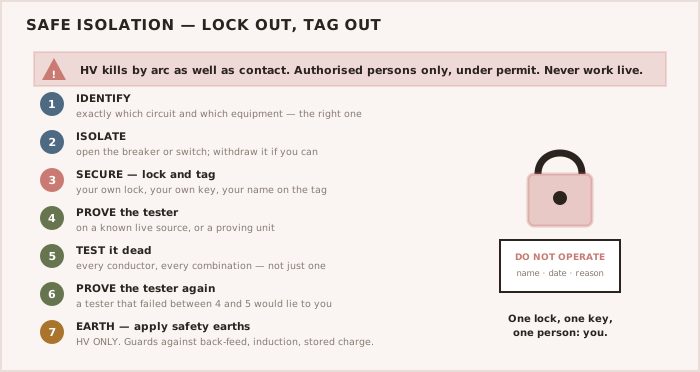
- Isolation is a system, not an action. Who authorises it, who verifies it, who holds the key, who proves dead, and who is permitted to restore. If that answer lives in one person's head, it is not a system.
- Automation hides faults. A power management system that keeps the lights on through a developing fault has, in a real sense, concealed it from you. The alarm history is a maintenance record. Read it.
- Redundancy is a claim until it is tested. Two of everything is worth nothing if both are fed from the same board, the same cooling loop, or the same lube-oil supply. Trace it yourself. On paper. Once.
WARNING — High voltage does not forgive The competence exists because people die. Safe isolation, proving dead, lock-out and permit to work are not paperwork — they are the machinery. The specific HV procedures on your vessel come from the equipment manufacturer, the vessel's safety management system and the flag state's rules, and this course does not attempt to restate them.
Take the approved course. Read your own vessel's HV procedure. Then read it again when you join a new boat, because it will be different.
Why the ETO is next door
The Coast Guard issues an Electro-technical Officer endorsement (11.335) at operational level, with a 750 kW floor. Its professional training list is the electrical department in six lines: onboard computer networking and security; radio electronics; integrated navigation equipment; ship propulsion and auxiliary machinery; instrumentation and control systems; and high-voltage power systems.
That is the deep specialist. You are not required to be them — and on most yachts you will not have one. Which is precisely why the management item exists: to make sure the chief can hold, supervise and question that domain even when there is nobody aboard who owns it full-time.
TIP — The ETO is the one free-standing STCW engineering credential — and management holders can pick it up 11.335(d): an applicant holding no other national or STCW endorsement receives the ETO endorsement without any corresponding national endorsement. There is no national ETO grade — 11.501 lists thirteen and ETO is not among them. It is the only exception to the rule at 11.201(a) that STCW rides on a national ticket.
And 11.335(c): a holder of OICEW, Second Engineer Officer or Chief Engineer Officer "will be allowed to receive the ETO endorsement upon completion of the requirements in Section A-III/6." If the electrical side is where your career is going, that door is open from where you already stand.
The habit to build
Every time an automated system does something clever on your behalf, ask what it just hid. A generator that started itself, a pump that swapped over, a breaker that reclosed. The plant is telling you something and the alarm panel is the only place it can say it.
The chief who reads the alarm history is the chief who is not surprised.