
Entry & progression
46 CFR 11.516(a) gives seven qualifying routes to Third Assistant Engineer. Not one. Seven. Pick yours before you spend three years on the wrong one.
The seven routes — 11.516(a)
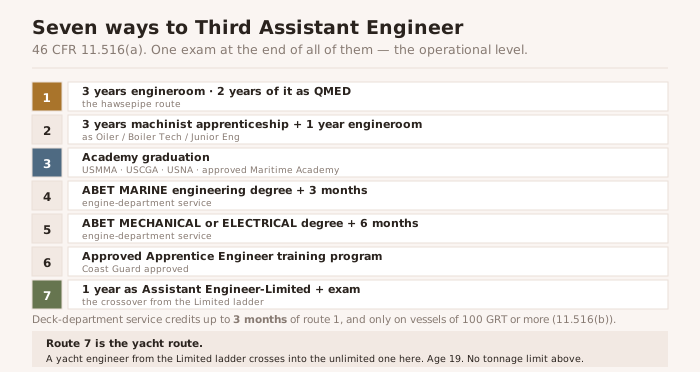
- Three years of engineroom service, two years of it as a QMED or equivalent. This is the hawsepipe. Longest road, no tuition fee.
- Three years apprenticed to the machinist trade, plus one year of engineroom service as Oiler, Boiler Technician/Watertender or Junior Engineer.
- Graduation from the US Merchant Marine Academy (engineering); the Coast Guard Academy with the onboard engineer officer qualification programme; the US Naval Academy with the same; or the engineering class of a state Maritime Academy approved under 46 CFR Part 310.
- An ABET-accredited MARINE engineering degree, plus three months of engine-department service.
- An ABET-accredited MECHANICAL or ELECTRICAL engineering degree, plus six months of engine-department service.
- Completion of a Coast Guard-approved Apprentice Engineer training programme.
- One year as Assistant Engineer-Limited of self-propelled vessels, plus the appropriate examination.
NOTE — Route 4 versus route 5 — three months against six The distinction is the accreditation on the degree, not the difficulty of it. An ABET marine engineering degree needs 3 months of engine-department service. An ABET mechanical or electrical engineering degree needs 6 months. Same regulation, double the sea time, because the marine degree already carries the shipboard content.
Route 1 is the yacht route, and it runs through QMED
Most people reading this are not going back to school. Route 1 is the road: three years in engine rooms, two of those years as a Qualified Member of the Engine Department. QMED is not a rank you drift into. It is a rating in 46 CFR Part 12 with its own examination — and note the ladder below you is Wiper → QMED, not Wiper → Oiler → QMED. Oiler is a QMED rating, one of five, alongside Boiler Technician/Watertender, Junior Engineer, Electrician/Refrigerating Engineer and Pump Technician/Machinist.
Deck credit — three months, and only three
Under 11.516(b), experience gained in the deck department on vessels of 100 GRT or more is creditable toward route (1) for up to three months. That is the number for this grade and this grade only. The Limited grades and DDE allow up to 25% or six months, whichever is less (11.504). OICEW allows three months. STCW Chief 750–3,000 kW allows two. Do not carry one number across the ladder — every rung has its own.
Two things that apply whichever route you take
- The one-third propulsion-mode rule (11.502(a)): at least a third of your minimum service must have been on the mode you are seeking — steam, motor or gas turbine. Lesson 1.4.
- The 11.503(b) horsepower formula: the vessels you served on decide your power ceiling. Three years on 900 kW yachts produces a Third Assistant with a low HP limit. Lesson 1.3.
CAUTION — Approved programmes change — check the current list Routes 3 and 6 depend on the programme being Coast Guard-approved on the day you apply. Approvals are added and withdrawn. Pull the current approval list and the checklist for Third Assistant Engineer from the National Maritime Center before you enrol in anything; do not rely on a course provider's word or on this page.