
Entry & progression
Overhauls are planned, not discovered. The management-level engineer decides when to open a unit, on what evidence, and with what parts, people and time already on the pier.
| Approach | Trigger | What it costs you |
|---|---|---|
| Breakdown | It failed | The vessel, the schedule, and often the component next to it |
| Planned / calendar-hours | The maker's running-hour interval | Opening healthy units; discarding serviceable parts |
| Condition-based | The measured condition crossed a limit | Instrumentation, discipline, and the judgement to read it |
Planned maintenance is the floor — the maker's intervals and the vessel's PMS are the baseline and the auditable record. Condition monitoring is what lets you argue with them intelligently, in either direction: to open a unit early because the evidence says so, or to run past an interval with class agreement because the evidence says the unit is healthy.
What you actually monitor
- Performance data — exhaust temperature deviation across units, peak and compression pressures, turbocharger speed, scavenge air pressure and temperature, cooling water temperatures in and out.
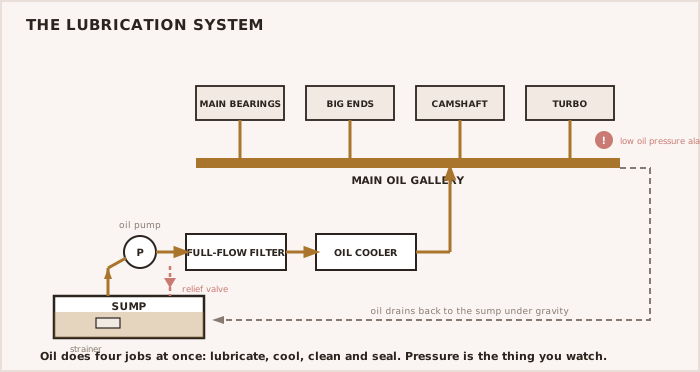
- Lubricating oil analysis — wear metals (iron, chromium, copper, lead, tin), water content, viscosity, total base number, insolubles. A wear-metal trend names the failing component before it makes a noise.
- Vibration analysis on rotating auxiliaries — pumps, purifiers, fans, turbochargers. Bearing defects announce themselves in the spectrum long before they announce themselves to the ear.
- Scavenge space and underpiston inspection — the cheapest and most direct look inside a running engine you will ever get. Do it, and record what you saw.
- Crankcase inspection and oil mist detection — the last line before a crankcase explosion.
Planning the overhaul
Before a unit comes apart
- Confirm the evidence justifies the work — performance deviation, oil analysis, hours, previous inspection findings.
- Confirm the parts are aboard, complete, and correct to the engine's serial number. A half-completed overhaul is worse than a deferred one.
- Confirm the lifting gear is certified and the special tools are present. Hydraulic tensioners and their pumps, not a long bar.
- Confirm the time, the people and the sea state — and that the plant can carry the vessel with the unit out.
- Write and brief a risk assessment and a permit where the work touches confined space, hot work, or stored energy.
- Isolate: fuel, starting air, turning gear engaged, lubricating oil, cooling water. Lock out. Tag out. Test dead.
- Record clearances and readings as found, before you disturb anything. The as-found data is the only data you cannot go back for.
WARNING — Turning gear and starting air kill people The two ways an engine kills the person working on it are starting air admitted to a cylinder with a person on the turning gear and the turning gear energised with a person inside. Both are prevented by the same discipline: physical isolation, locked, tagged, and verified by the person whose hands are going in.
Not the person who signed the permit. The person whose hands are going in.
The judgement, not the procedure
Any competent engineer can follow an overhaul manual. What the management level is testing is the decision around it: whether the evidence justifies opening the unit at all; whether you have the parts to finish what you start; whether the remaining plant will carry the vessel through the job; and whether you can say no to a departure time when the answer is no. A chief who cannot say no is not managing the plant. The plant is managing them.
CAUTION — The maker's manual outranks this page Clearances, torque figures, running-hour intervals, condemning limits and overhaul sequences are specific to your engine and are not in this fact base. Nothing here is a substitute for the engine builder's manual, the vessel's PMS, and the requirements of class. Where class has an interest in the interval, get class agreement in writing before you extend it.