
Entry & progression
This is the most important sum in the course. Your propulsion-power ceiling is not chosen, not applied for and not examined. It is calculated from the vessels you served on — and the calculation decides whether you walk out with an unlimited ticket or a 5,000 HP one.
NOTE — 46 CFR 11.503(b) — verbatim *"When an applicant for an original or raise of grade of an engineer endorsement, other than a DDE, has not obtained at least 50 percent of the required experience on vessels of 4,000 HP/3,000 kW or more, a propulsion power limitation is placed on the MMC based on the applicant's qualifying experience. The endorsement is limited to the maximum propulsion power on which at least 25 percent of the required experience was obtained, or 150 percent of the maximum propulsion power on which at least 50 percent of the service was obtained, whichever is higher. Limitations are in multiples of 1,000 HP/750 kW, using the next higher figure when an intermediate horsepower is calculated. *When the limitation as calculated equals or exceeds 10,000 HP/7,500 kW, an unlimited propulsion power endorsement is issued."
Read it as a gate, then two branches
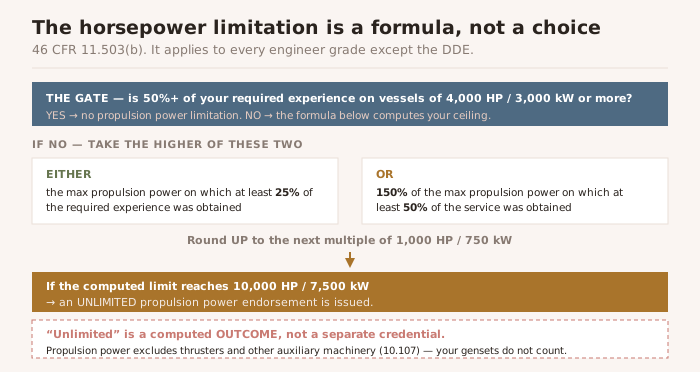
- The gate. Did you get at least 50% of your required experience on vessels of 4,000 HP / 3,000 kW or more? If yes — no limitation. Done.
- If not, compute two numbers and take the higher: (a) the maximum power on which at least 25% of the required experience was obtained; (b) 150% of the maximum power on which at least 50% of the service was obtained.
- Round up to the next multiple of 1,000 HP / 750 kW.
- If the answer is 10,000 HP / 7,500 kW or more, the endorsement is issued unlimited.
Work one
An applicant qualifies for Third Assistant Engineer by route 1: 36 months of required engineroom service. Twelve months were on a 6,000 HP vessel; twenty-four on a 3,000 HP vessel.
- Gate: only 12 of 36 months — 33% — were on vessels of 4,000 HP or more. Under 50%, so a limitation will be placed.
- Branch (a): 25% of 36 months is 9 months. The highest power on which at least 9 months were obtained is 6,000 HP (there were 12 months there). → 6,000 HP.
- Branch (b): 50% of 36 months is 18 months. The highest power on which at least 18 months were obtained is 3,000 HP (24 months there). 150% of 3,000 = 4,500 HP → round up → 5,000 HP.
- Higher of the two: 6,000 HP. The endorsement is issued as Third Assistant Engineer, limited to 6,000 HP.
Change one input and the answer moves. Had 18 of those 36 months been on the 6,000 HP vessel, the applicant would have cleared the 50% gate and no limitation would have been placed at all. Where you take your berths is a licensing decision.
WARNING — This is where yachts hurt you Propulsion power excludes thrusters and auxiliary machinery (46 CFR 10.107). Your thrusters, gensets and hydraulics do not count. A yacht with an enormous electrical load and modest mains can sit well below 3,000 kW.
Three years exclusively on such yachts produces a Third Assistant Engineer with a low horsepower limitation, and that limitation follows you up the ladder.
Removing the limitation — 11.503(c)
Service on vessels of 4,000 HP / 3,000 kW or more buys it back. Any one of four:
- 6 months in the highest grade endorsed → all HP limits removed.
- 6 months as an engineer officer in any capacity other than the highest grade → limits removed for that grade, and the next higher grade raised to the HP of the vessel served on.
- 12 months as Oiler or Junior Engineer while holding Third Assistant Engineer or Assistant Engineer-Limited → all HP limits removed on that endorsement.
- 6 months as Oiler or Junior Engineer while holding Second Assistant Engineer → all HP limits removed on the Third Assistant endorsement.
11.503(d): removal may be granted without further written examination where the Coast Guard considers one unnecessary. The limitation is not a punishment — it is a statement about the plants you have run, and it is undone by running bigger ones.