
Entry & progression
Blackout. Engine room fire. Loss of propulsion. These are the three events the department exists to prevent and, failing that, to survive. Everything in this course has been building to the ten minutes described here.
Blackout at sea
The vessel loses the plant. Lighting goes to emergency. Steering may be gone. Propulsion is gone. She drifts and lies beam-on, and if there is weather or a lee shore, the clock that matters is not the one in the engine room.
- Tell the bridge immediately. Not once you have fixed it. Immediately. The bridge's options — anchor, tug, an urgency broadcast — take time you are about to spend.
- Confirm the emergency generator has started and is on the board. If it has not, start it manually. Know how, in the dark, by feel.
- Identify the cause before you restart. A fuel-system failure, an overload, a cooling-water failure and an earth fault each demand a different restoration. Restarting into an uncleared fault gives you a second blackout, and you may not get a third go.
- Restore in sequence: essential services, then steering, then propulsion, then the rest. Do not throw the hotel load back on and trip the set you just started.
- Give the bridge a time, and update it honestly. "Twenty minutes" that becomes an hour destroys their decision-making. "I do not know yet" is a legitimate answer.
Engine room fire
The most dangerous fire at sea. High-pressure fuel or lubricating oil spraying onto a hot surface — an exhaust manifold, a turbocharger casing — grows faster than anyone expects, in a compartment full of the fuel to feed it.
The sequence, and it is not negotiable
- Raise the alarm. Tell the bridge. Do not fight it quietly first.
- Attack it immediately if it is small and you can do so safely — the first extinguisher beats the fixed system by a wide margin.
- Evacuate and account for every person. A headcount before the space is closed. This is the step that gets skipped and it is the step that kills.
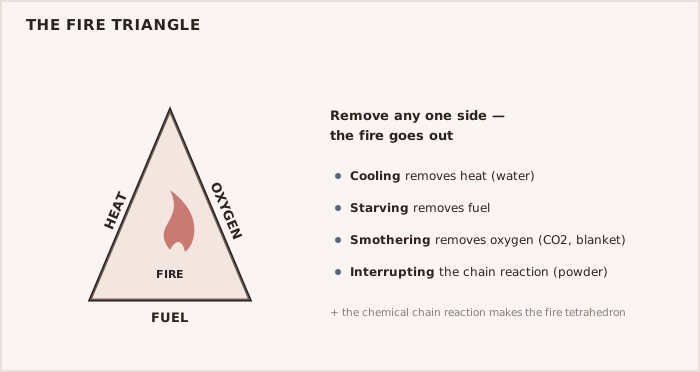
- Isolate: quick-closing fuel valves, remote stops for pumps, fans and purifiers, ventilation shut, dampers and skylights closed. The fixed system will not work in a ventilated space.
- Seal the compartment. Every opening.
- Release the fixed system on the master's order, from outside the space, and record the time.
- Boundary-cool. Do not reopen. Reopening onto a hot compartment gives it the oxygen it has been waiting for.
WARNING — The headcount is the step people die on Every fixed gas or foam system in a machinery space is designed on the assumption that the space is empty. The single point of failure in the entire sequence is a person unaccounted for.
Count people by name, out loud, against a list, before the space is sealed. Not "I think everyone is out." By name. This is why 46 CFR 11.201(h)(2)(iv) requires Advanced Firefighting of every engineer endorsement, down to the DDE of a 1,000 HP boat.
Loss of propulsion
Propulsion can be lost with the electrical plant intact — a protective trip, a gearbox or clutch failure, a CPP failure, a shaft casualty. The priorities do not change.
- Tell the bridge first, with the truth. Available power, available propulsion, best estimate of time.
- Do not defeat a protective trip to restore propulsion under pressure. It fired for a reason you have not found yet. If the master judges the vessel must move regardless — a lee shore, a collision risk — that is the master's decision, taken with your advice, and you record it.
- Keep steering. A vessel with steering and no propulsion is not the same casualty as one with neither.
- Think about the next failure. Casualties come in sequences.
And afterwards: write it down while it is fresh. Times, readings, actions, orders, who was where. The investigation will come — class, the flag, the insurers, the Coast Guard — and your contemporaneous notes are the only version that will not have decayed. A chief engineer's memory is not evidence. A chief engineer's log is.