
Entry & progression
The management-level STCW training explicitly includes the management of electrical and electronic control equipment (11.325(a)(3), 11.327(a)(3)), and high-voltage power systems is one of the six professional subjects for the ETO (11.335(a)(4)). Electricity is management-level content, not a specialism you delegate.
A modern large yacht carries an electrical plant out of proportion to its propulsion. Hotel load, stabilisers, thrusters, air conditioning, hydraulics, galley — the ship's service demand can dwarf what the mains draw. It is worth restating the licensing consequence: none of that counts as propulsion power (46 CFR 10.107 excludes thrusters and auxiliary machinery). The plant that dominates your working life contributes nothing to your horsepower limitation.
Why high voltage changes the job
Below about a thousand volts, a mistake is a shock and a bang. Above it, the physics changes. Air stops being a reliable insulator. Energy is delivered by arc without contact. Approach distance becomes a hazard in itself, and the arc flash — the thermal and pressure event, not the electrocution — becomes the thing most likely to kill or maim the person standing in front of the switchboard.
- Nobody works on HV without authorisation, in writing, from a named competent person.
- Permit to work, every time. No exceptions for quick jobs. Quick jobs are how people die.
- Earthing is not optional. After isolation, the conductors are proved dead and then earthed — because cable capacitance, induced voltage from adjacent circuits and stored energy will all re-present a lethal potential on a circuit you switched off ten minutes ago.
- PPE is arc-rated, and it is worn. Arc-flash clothing, face shield, insulating gloves, insulating mat.
- Test the tester. Prove the instrument on a known live source before and after you prove the circuit dead.
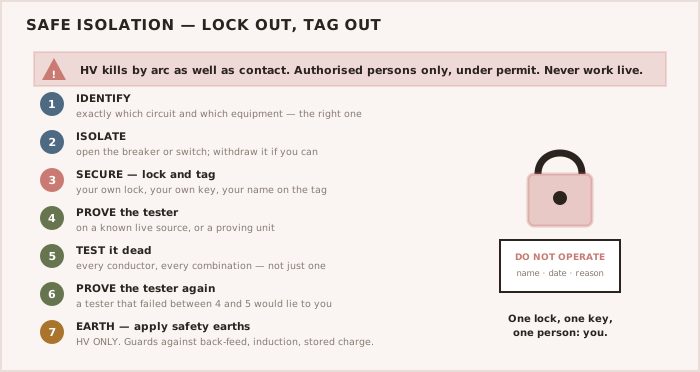
Safe isolation — the sequence
Lock out / tag out — the discipline that does not bend
- Identify the exact circuit, from the drawing, and verify the drawing against the plant.
- Isolate — open the breaker, rack it out, open the isolator. A tripped breaker is not an isolation.
- Secure — apply the lock. Personal lock, personal key, in your pocket.
- Tag — who, when, why, and how to reach you.
- Prove dead — with an instrument you have proved on a known source, on every conductor, phase to phase and phase to earth.
- Earth where the system requires it — HV always.
- Only then, work.
- Restore in reverse, by the same person, with a documented check that the circuit is clear of people and tools.
WARNING — One lock, one key, one person The rule that survives every investigation into an electrical fatality is this one: the person exposed to the hazard holds the key. Not the duty engineer. Not the ETO. Not a lock hanging on a board.
Multiple workers, multiple locks, on a hasp. The circuit cannot be restored while a single lock remains. If someone has gone ashore with their lock on, the circuit stays dead until they come back. That is the point of the system, not a flaw in it.
Managing the plant, not just the fault
- Load sharing and the blackout margin. Know what will trip if the largest generator drops off at the worst moment. Preferential trips exist so that the plant sheds the air conditioning rather than the steering.
- Insulation resistance trending — a falling megger reading on a motor is a fault forming, not a fault present. Trend it and you fix it alongside; ignore it and you fix it at sea.
- Earth-fault monitoring. The first earth fault on an insulated system does nothing. The second one is a short circuit. Find the first one.
- Shore power and yard periods. Most electrical accidents happen when the plant is half-alive and the responsible person has changed.
CAUTION — HV thresholds, PPE ratings and approach distances are standards work Voltage bands, arc-flash boundary calculations, PPE categories, approved earthing procedures and competent-person definitions come from class rules, the flag administration and the applicable electrical standards — none of which is in this fact base. Work to your vessel's HV safety management procedures and your class rules, not to a training page.