
Entry & progression
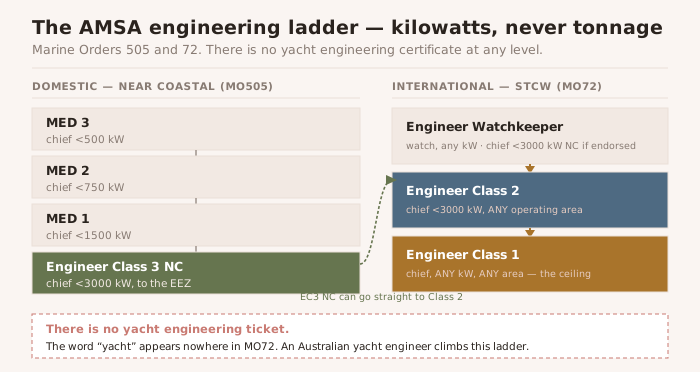
Engineer Class 3 near coastal is the top of the domestic engineering ladder. It is also the door into the international one. Almost nobody outside the system understands how much authority it carries.
The name undersells it. People hear "near coastal" and picture a harbour ferry. Marine Order 505 defines near coastal as "waters including inland waters and waters to the outer limits of the exclusive economic zone of Australia". That is the whole EEZ. There is not a single nautical-mile figure in MO505 for it. Near coastal means 200 miles offshore, on both sides of the continent, all the way around.
The entitlement
| Role | What the EC3 NC permits |
|---|---|
| Chief engineer | Vessel with an inboard engine under 3000 kW, to the outer limits of the EEZ |
| Chief engineer | Outboard-engined vessels — unlimited propulsion power |
| Engine room | Any vessel under 3000 kW, to the outer limits of the EEZ |
Read the first row again. Chief engineer, in charge, on a vessel of up to three thousand kilowatts, out to the edge of the economic zone. That is a serious ship — a large ferry, an offshore support vessel, a big charter yacht working the Australian coast. The domestic ladder carries far more chief-engineer authority than most people assume, and the EC3 sits at the top of it.
The 80 metre question
CAUTION — AMSA's own sources disagree — do not rely on either AMSA's older Engineer Class 3 NC web page says the certificate allows work "in the engine room of a vessel up to 80 metres long with propulsion power up to 3000 kilowatts". The current 2023 guidance notice omits the 80 metre limit entirely.
We have not resolved which governs. If the length of the vessel you intend to work on sits anywhere near 80 metres, that question is not academic — it decides whether you are legally the chief engineer or not. Ask AMSA in writing, and get the answer in writing, before you sign an employment contract.
Kilowatts, never tonnes
Australian engineering certificates are scoped in kilowatts. Full stop. There is no gross tonnage figure anywhere in the engineering system — not in MO505, not in MO72, not on any AMSA engineer page. The numbers that matter are 375, 400, 500, 750, 1500 and 3000 kW.
Deck officers live in metres and tonnes. Engineers live in kilowatts. If somebody tells you they hold an "Engineer under 3000 GT" ticket, they are describing a certificate that does not exist.
The outboard anomaly
The outboard entitlement is unlimited at every rung of the domestic ladder, right down to Marine Engine Driver Grade 3. That is not an oversight. Outboards are self-contained units that get swapped rather than overhauled in place, and the regulator has scoped them accordingly. It matters commercially: a fast crew-transfer or dive vessel running four large outboards is legally within reach of a ticket far below what its total installed power might suggest.
Below the EC3 sit the three Marine Engine Driver grades. Above it, in a different legal universe entirely, sits the STCW ladder. Understanding what the EC3 is worth in both directions is what the rest of this module is about.