
Entry & progression
The EC3 is a diesel ticket. Your qualifying sea service is on inboard diesels of 400 kW and up, and your entitlement runs to 3000 kW. Everything in this module assumes compression ignition.
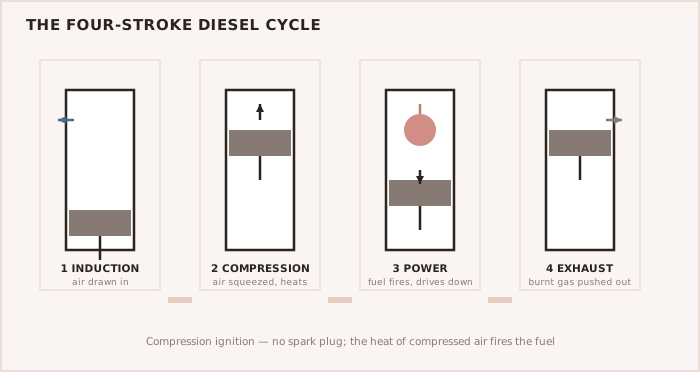
The four-stroke cycle is four piston strokes and two crankshaft revolutions. Induction: the inlet valve opens, the piston descends, air enters — charge air, usually turbocharged and cooled. Compression: both valves shut, the piston rises, the air is compressed to a pressure and temperature above the fuel's auto-ignition point. Power: fuel is injected at the top of the stroke, ignites on contact with the hot air, and the expanding gas drives the piston down. Exhaust: the exhaust valve opens and the piston rises to sweep the gas out.
There is no spark. The heat of compression is the ignition source, and that single fact explains most diesel faults. If the engine will not start, the air was not hot enough or the fuel did not arrive. If it knocks, the timing of ignition is wrong. If it smokes, the ratio of fuel to air is wrong.
Reading smoke
| Exhaust | Usually means |
|---|---|
| Black | Unburnt fuel — overload, dirty injectors, restricted air, fouled turbo, dirty air filter |
| Blue | Burning lube oil — worn rings, worn liners, worn valve guides, overfull sump |
| White | Unburnt fuel or water — cold engine, misfiring cylinder, or water in the combustion space |
TIP — White smoke on a warm engine is not a fuel problem until you have proved it is not water Persistent white smoke from a hot, loaded engine deserves a cylinder head gasket, a cracked head or a liner in your list of suspects long before you start blaming injectors. Water in a cylinder is a bearing failure and a bent rod waiting to happen. Check the header tank level, check for oil in the water and water in the oil, and take it seriously.
What actually breaks
Not the crankshaft. In practice, the diesel itself is astonishingly robust, and the failures that put a vessel out of service almost always originate in the systems attached to it — fuel that is dirty, cooling water that is not flowing, lube oil that is contaminated, air that cannot get in or exhaust that cannot get out.
- Fuel contamination — water and microbial growth in the tank. The most common cause of engine failure at sea, and entirely preventable.
- Cooling failure — a blocked strainer, a failed impeller, a corroded heat exchanger. Minutes from noticed to seized.
- Lube oil — low level, contaminated, or a failed pump. The engine will run beautifully right up until it does not.
- Turbocharger — fouling, surging, bearing failure. Feeds directly back into black smoke and lost power.
- Injectors — poor atomisation, dripping, sticking. Rough running, smoke, and washed liners.
The instruments tell you first
Exhaust temperature per cylinder, cooling water inlet and outlet, lube oil pressure and temperature, charge air pressure and temperature, fuel pressure differential across the filters. Every one of those is a leading indicator, and every one of them moves before the alarm sounds. The difference between an engineer and a person who watches alarms is the trend line.
Learn what your plant reads when it is well. Write it down. A cylinder exhaust temperature 40 degrees above its neighbours is meaningless unless you know it used to be level with them.