
Entry & progression
Fuel is the most common cause of engine damage at sea, and almost all of it is preventable at the purifier. This lesson is treatment, purification, and the fuel that ruined the engine.
The fuel path
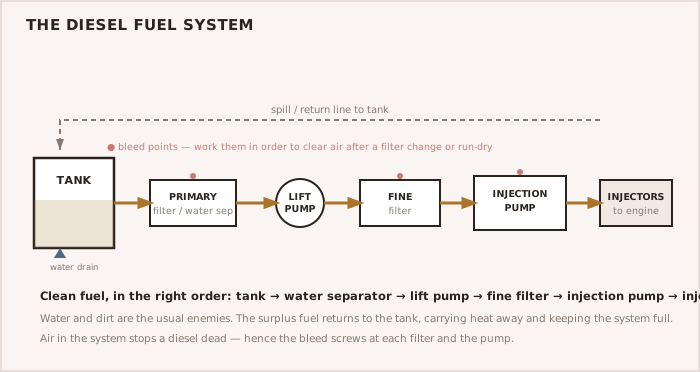
- Bunker tanks — where the fuel lands, and where water settles
- Settling tank — heated, given time, drained of water and sludge from the bottom
- Purifier / centrifuge — the machine that actually cleans the fuel
- Service tank — clean fuel, ready for use
- Booster / supply system — filters, heaters, viscosity control
- Fuel injection pumps and injectors — clearances measured in microns
Drain the settling tank every watch. It takes ninety seconds and it is the single cheapest piece of engineering you will do all day.
Cat fines — the fuel that ruined the engine
WARNING — Aluminium and silicon. Harder than your liners. Catalytic fines are microscopic aluminium-silicate particles left over from refinery cracking. They are harder than the cylinder liner, harder than the piston rings, and harder than the injector needle. Once they reach the combustion space they lap the liner into a mirror finish, wreck the rings, and score the pump plungers.
A liner can be worn out in hundreds of hours by a single bad bunker. There is no repair at sea and no warranty claim that gives you back the season.
The purifier is the only defence. Run it at reduced throughput — the slower the fuel passes through the bowl, the more of the fines come out. And take the bunker sample, seal it, and keep it. Without a retained sample you cannot prove anything to anybody.
The purifier
A centrifuge spinning at thousands of rpm, using density difference to throw water and solids outward while clean oil is drawn from the centre. Get the settings right or it does nothing useful:
- Correct gravity disc for the fuel density — too small and you lose oil overboard with the water; too large and the water seal breaks and dirty oil goes to the clean side
- Correct temperature — the fuel must be heated to specification, because separation efficiency depends on viscosity
- Reduced throughput for cat fine removal. Two purifiers in series, both slow, beats one purifier fast
- Regular sludge discharge, and check that the bowl is actually discharging
Lubricating oil
Lube oil does four jobs at once: it lubricates, it cools, it cleans, and it neutralises acid. Its TBN — total base number — is the reserve of alkalinity that neutralises the sulphuric acid formed when sulphur in the fuel burns. Burn low-sulphur fuel with a high-TBN oil and you get deposits; burn high-sulphur fuel with a low-TBN oil and you get corrosive wear. Match the oil to the fuel.
Send oil samples ashore for analysis on schedule. Wear metals in a lab report are the only way you will see a bearing failing three months before it fails.
CAUTION — Sulphur limits and the Australian application of MARPOL Annex VI The global cap on fuel sulphur content is 0.50% m/m, and 0.10% inside an emission control area — that is the international position. How Annex VI is given effect in Australian law, and which Australian waters are affected, was not confirmed for this course. Confirm current limits and the changeover recording requirements with AMSA before you plan a fuel changeover.