
Entry & progression
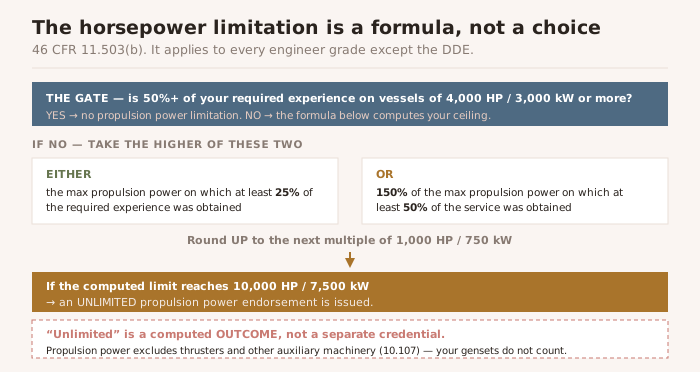
The horsepower limit on your ticket is calculated from your service, not chosen from a menu. "Unlimited" is an outcome of the formula, not a separate credential. The formula does not apply to DDE — 11.503(a) carves it out.
The formula — 11.503(b), verbatim
NOTE — 46 CFR 11.503(b) "When an applicant for an original or raise of grade of an engineer endorsement, other than a DDE, has not obtained at least 50 percent of the required experience on vessels of 4,000 HP/3,000 kW or more, a propulsion power limitation is placed on the MMC based on the applicant's qualifying experience. The endorsement is limited to the maximum propulsion power on which at least 25 percent of the required experience was obtained, or 150 percent of the maximum propulsion power on which at least 50 percent of the service was obtained, whichever is higher. Limitations are in multiples of 1,000 HP/750 kW, using the next higher figure when an intermediate horsepower is calculated. When the limitation as calculated equals or exceeds 10,000 HP/7,500 kW, an unlimited propulsion power endorsement is issued."
How to read it
- The trigger. Did at least 50% of your qualifying service happen on vessels of 4,000 HP / 3,000 kW or more? If yes, no limitation is placed. If no, the formula runs.
- Branch one. Find the maximum propulsion power on which at least 25% of your required experience was obtained.
- Branch two. Find the maximum propulsion power on which at least 50% of your service was obtained, and take 150% of it.
- Take whichever is higher. That is your number.
- Round up to the next multiple of 1,000 HP / 750 kW.
- If the result reaches 10,000 HP / 7,500 kW, the endorsement is issued unlimited.
11.503(a) tells you what to measure: the total shaft propulsion power of each vessel on which you have served.
Propulsion power excludes your gensets
WARNING — Thrusters and auxiliaries do not count — 46 CFR 10.107 "Propulsion power means the total maximum continuous-rated output power of the main propulsion machinery of a vessel... and excludes thrusters and other auxiliary machinery."
A yacht with a large electrical plant, bow and stern thrusters and a room full of hydraulics can still sit well below the thresholds. The generators do not count. The thrusters do not count. Only the mains count.
And do not "correct" the Coast Guard's arithmetic. 46 CFR 10.107 defines a kilowatt as 1⅓ horsepower, so 3,000 kW is 4,000 HP by regulation. Quote the pairs as the CFR writes them: 1,000 HP / 750 kW; 4,000 HP / 3,000 kW; 10,000 HP / 7,500 kW.
Removing the limit — 11.503(c)
The limitation is not permanent. Service on vessels of 4,000 HP / 3,000 kW or more buys it off:
| Service on vessels of 4,000 HP / 3,000 kW or more | Effect |
|---|---|
| 6 months in the highest grade endorsed | All HP limits removed |
| 6 months as an engineer officer in any capacity other than the highest grade | Limits removed for that grade; the next higher grade raised to the HP of the vessel served on |
| 12 months as Oiler or Junior Engineer while holding 3rd A/E or Assistant Engineer-Limited | All HP limits removed on that endorsement |
| 6 months as Oiler or Junior Engineer while holding 2nd A/E | All HP limits removed on the 3rd A/E endorsement |
And 11.503(d): the removal may be granted without further written examination if the Coast Guard considers an examination unnecessary.
TIP — Two of those rows are a rating job Look at row three. Twelve months as an Oiler or Junior Engineer — a QMED rating — while holding Assistant Engineer-Limited removes all horsepower limits from that endorsement. If the big-horsepower officer berth is not available to you, the big-horsepower rating berth may be. It counts.